 Today's composer of the day is Alban Berg.
February 9, 1885 - December 24, 1935
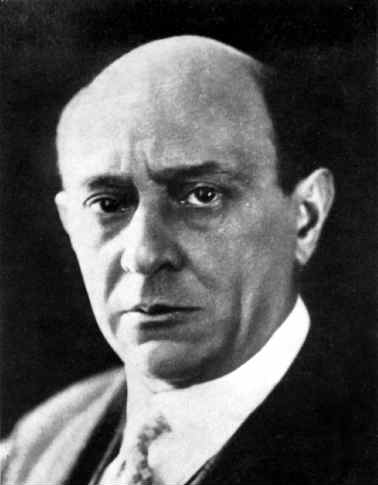
(Photo: Alban Berg as played by Christopher Walken.)
Today would have been the 125th birthday for Mr. Berg, if he'd only had superhuman immortality. Berg represents Part II of our three part Composer of the Day! series on Second Viennese School composers. (see Part I here)
Berg was born into wealth, and died in poverty, the latter due to blacklisting by the Nazis. After knocking up one of his family's servants at age 17, Berg did the practical thing and got a job as a bookkeeper. By the age of 19, though, Berg did the unpractical thing and started to study composition with Arnold Schoenberg.
Berg is perhaps best known as the composer most-often cited by twelve-tone apologists and by haters of modernist music in need of some credibility. This is primarily due to Berg's reputation as a composer who successfully combined the musical sensibilities of Romanticism with Expressionist ideals and post-tonal musical languages.
Berg also ascribed to a system of composition that ventured to compose entire works of music from a single motive or musical gesture. This conservation of ideas manifests itself in many of his works, including the musicologist's wet-dream Lyric Suite, of which the first movement, for example, is derived entirely from a series of intervals in the very first bar. His most famous works are probably his Violin Concerto and his two operas, Wozzeck and Lulu. Both operas are touching stories of hope and the unwavering human spirit; the former about a soldier driven insane by doctors who then stabs his mistress, and the latter about a woman who kills her husband, kills her doctor, becomes a prostitute who is in turn killed by Jack the Ripper.
Here is a small bit from one of my favorite moments of Lulu:
Like his serialist comrade, Anton Webern, Berg suffered a rather tragic and gruesome death when he was (likely) bitten by an insect and died of blood poisoning, worsened by a little home surgery performed by his wife. He died on Christmas Eve, which, of course, totally sucks.
In the unlikely case that you haven't heard his music, please remedy that immediately. His music is a marvel of carefully executed musical architecture, and of lyrical and emotional depth.
Besides the already named works, his Chamber Concerto (1925) and Altenberg leider (1911-12) are amazing pieces more than worth the listen.
Chamber Concerto (1925), mvt. 1:
Five Orchestral Songs on Postcard Texts of Peter Altenberg, Op. 4 (1911-12):
-----------------------------
"I think the origin of all this clamour for tonality is not so much the need to sense a relationship to the tonic, as a need for familiar chords: let us be frank and say "for the triad"; and I believe I have good reason to say that just so long as a certain kind of music contains enough such triads, it causes no offence, even if in other ways it most violently clashes with the sacred laws of tonality."
-- Alban Berg, quoted in Reich, Willi (1971). Schoenberg: A Critical Biography, p.34.
2/9/10
Composer of the Day!
1/4/10
In Defense of Modernism (vis-a-vis Romanticism), or: The Conductor's Gambit
I thought this NYT review was interesting. Writing of the NY Phil's last 2009 subscription concert, Allan Kozinn's reading is that conductor Alan Gilbert
"built this program with what appeared to have been the modest but telling goal of getting the Philharmonic audience to warm to Webern’s concise, focused 12-tone music"
and his argument is pretty convincing based on the evidence. Also, it is a thoughtful and well-written article. (Sorry.)
Moreover: what's the deal with that, anyway? Yeah, it's Webern. It's modernist. It's also eighty fucking years ago.
Besides, it's austere, refined, and brief. It's not violent, really, or confrontational or sexual, if you consider that Dada and Surrealism are going on about the same time.
 Figure 1: Confrontational, depersonalizing, topical. Interesting, but not very Webernian.
Neither is it a cacophonous mess.
 Figure 2: Rauchenberg, whose beautiful cacaphonous messes can be outstanding.
 Figure 3: Albers. Nice.
Romanticism. Right? At least that's the purported take of Gilbert for this concert.
So, audience...and not any audience, New York Philharmonic Subscription Concert Audience, for crap's sake: Why do you hate Webern so much?
The stage of Avery Fisher Hall was decked out with flowing blue curtains and floral arrangements on Tuesday evening in preparation for the New York Philharmonic’s New Year’s Eve concert. But Alan Gilbert’s more pressing business was the orchestra’s final subscription program for 2009, an inventive juxtaposition of works by Webern, Mozart and Schumann.
I like this. Is it superfluous to burn some column inches describing the hall? In this case, no. Here's why:
The stage of Avery Fisher Hall was decked out with flowing blue curtains and floral arrangements on Tuesday evening in preparation for the New York Philharmonic’s New Year’s Eve concert.
Yay, festive! Curtains! Flowers! Let's listen to some holiday cheer. Or, better: some goddamn Webern.
 Figure 4: ...and a Happy New Year!
Mr. Gilbert built this program with what appeared to have been the modest but telling goal of getting the Philharmonic audience to warm to Webern’s concise, focused 12-tone music, by way of the Symphony (Op. 21), which he conducted (and spoke about) in the second half.
Fascinating, and hilarious. And, potentially, a good time. What, I wonder, was his strategy?
And he surrounded the symphony with very different works, all meant to undercut what some listeners still regard as its abstruse harshness.
How is, say, Mahler not unbelievably abstruse? Canons seem pretty simple to comprehend compared to the fourteenth freaking modulaton to yet another far-off key in the middle of a two-hour symphony. But sadly, no.

Figure 5: "Oh, I get it! Because I know that chord!"
(One could argue that it is exactly this sort of abstruseness that Webern was trying to avoid.)
His first move in this endeavor was to offer a reminder of Webern’s unabashedly Romantic roots by conducting “Im Sommerwind,” a student work from 1904, the year Webern became a disciple of Schoenberg (who was also writing in a tonal, essentially Romantic style at the time).
Ah, the old appeal-to-the-composer's-early-work gambit. Why is it a gambit? What's being sacrificed, and for what potential gain?

Figure 6: Queen's Gambit. Classic.
The upside is that the audience might get (like and/or understand?) it. But in drawing so many lines to Webern's Romanticism, are we sacrificing some of its Modernism?In this case, I don't think so. Webern's Modernist (indeed, his abstract-abstruse-thorny-difficult-intellectualized-elitist Modernist) credentials are well-established.
You can hear the composer’s influences clearly: its lush string shimmer, its dynamic ebb and flow and its sense of the dramatic and picturesque have roots in the Strauss tone poems, and hints of Mahler (in bright-hued woodwind episodes) and Wagner (in grandly modulating chord progressions) waft through the piece.
Embeddence 2: Im Somerwind (part 2).
Conductors often perform “Im Sommerwind” as a way of saying, “See, Webern isn’t so bad,” and most of the time they leave it at that; listeners interested in hearing more are on their own.
But no!
Mr. Gilbert used the Philharmonic’s sweeping, colorful account to show that the Webern who wrote this spare, pointillistic Symphony from 1928 was schooled in the Romantic mainstream, and built on it.
Good, good.
He tried to say so directly in his spoken comments but was momentarily derailed: when he suggested that Webern’s themes are sometimes almost melodic, the audience tittered, leaving Mr. Gilbert to say he was serious.
Ha ha ha! It's great that the audience doesn't like it because they like that they don't understand it. America, fuck yeah!

Figure 7: Wary of other cultures and the unfamiliar in general, latte-sipping New York Elitist Liberal Concert-Goers relax with traditional lawn-games secure in the knowledge that some over-educated conductor asswipe's not going to tell them what a melody is.
He brought reinforcements to make his case in this 7-minute introduction to the 10-minute score.
First, ten minutes is a really slow Op. 21. Second, he brought up more people to tell the audience, "No, really! It's good!"?

Figure 8: Try Webern, or new Cinnamon Webern! Mikey likes it!
John Mangum, the orchestra’s artistic administrator, spoke briefly about his fascination with Webern’s way of distributing thematic fragments through the orchestra, and Eric Bartlett[,] a habitué of new music ensembles before he joined the Philharmonic’s cello section, advised simply listening to the flow of sound and not worrying about the rules of 12-tone composition or other technical or philosophical underpinnings.
The Webern Symphony had celebrity endorsements? Does it come with a free ShamWow?

Figure 9: A bill of goods, for sale.
The performance was almost anticlimactic, given the work’s brevity and textural transparency.
Yeah. It's not, in the end, Romantic music. Brevity and transparency are among its Modernist virtues.
Mr. Gilbert led a gracefully paced performance that made much of the feathery textures in the opening movement and the sprightly variations that make up the finale. And the Philharmonic’s playing, polished and warm,...
...was really good Modernism, right?
...offered occasional glimpses — in the rich vibrato on a violin line, the vigorous rendering of a woodwind figure — of the Romantic who wrote “Im Sommerwind.”
Oh. Well, shit. Maybe it was a gambit after all. Still, if it gets 'em listening, so much the better.
As a way of showing that the episodic qualities of the Webern Symphony have historical roots,...
Ah, interesting!
...Mr. Gilbert followed it (and closed the concert) with Schumann’s Symphony No. 2 (Op. 61), in a taut, beautifully burnished performance that capitalized on the orchestra’s virtuosity without overstating it.
What an odd choice, although it effectively speaks to (in its own way, as explicated by Kozinn) the Modernism-Romanticism link.
And between the two Webern scores the pianist Leif-Ove Andsnes joined the orchestra for an elegant, dynamically fluid reading of Mozart’s Piano Concerto No. 23 in A (K. 488).
It's quite odd that a pianist of this stature playing possibly the quintessential Piano Concerto gets only a single sentence at the end of the review. It shows, I think, the impression that the overall structure of the concert program had on the reviewer, which is fascinating in its own right.
And so is the concert itself. Clearly there are as many similarities as differences between Modernism and Romanticism, and if highlighting these issues for the audience results in the appreciation (and, really, even performances) of some unjustly-derided music, I'm all for it.
Sometimes grim insistence that difficult art should be accepted immediately on its own terms is a tough pill to swallow.

Figure 10 (Kandinsky, Composition No. 7): Like this, goddamit! LIKE IT RIGHT GODDAMN NOW!
4/16/09
Your Iatrophobia Is Showing
Subtle is thy hand, for a serialist shall’nt love receive. Amidst a tasteful amount of gushing over some waltz by Strauss Junior and a Bruckner symphony, this:
[Berg’s Violin Concerto] explores the variety of emotion available to 12-tone compositions...
Subtle, indeed. Did you catch Tennessean critic Jonathan Neufeld’s slight jab, suggesting that there’s a limitation to the variety of emotion inherent in the 12-tone technique?
While it is not conclusive that the above is anti-serialist, there’s this one, which refers to the Laura Turner Hall’s fantastic acoustics for Bruckner’s music:
The same could not be said of the intensely expressive but intricately detailed Berg Violin Concerto. [italics mine]
Expressive BUT intricately detailed? Not sure what Jonathan’s going for—we’ve seen over and over serial music panned for its complexities. So it makes sense to think that Jonathan is implicating Berg’s intricate details as the main culprit, derailing what was otherwise a perfect acoustic display.
On the other hand, a wet hall might not be the perfect condition for the concerto. In my experience, this hasn’t been a problem. So I’ll leave that one in the air.
However, this might prove conclusive:
Berg's orchestration conspired to keep violinist James Ehnes from being heard as clearly as he might have been in a drier, more clinical, hall.
Oh, I get it! So, the orchestration ruined the performance.
See, it couldn’t have been the performer:
Nevertheless, he drew a pure, sweet and full tone, especially in the upper registers, that was a genuine pleasure to hear.
It couldn’t have been the new hall’s acoustics—Bruckner shines there:
Bruckner's huge sonorities and broad-brush Wagnerian drama, along with exposed but clear and full-voiced wind ensembles, come off extremely well in the richly toned Laura Turner Concert Hall.
So it must have been Berg’s orchestration, which requires a drier (don’t forget, serialism is erroneously synonymous with dry), more clinical hall (read: a sterilized operating room), because, as we all know, serialism is emotionally unavailable even if it is intensely expressive.
Like dermatological surgeons.
Graph 1. A place for skin graphs and serialism
-
2/24/09
Return: Wherein Self-Fulfilling Prophecy Is Achieved Through Reinforcement of Stereotypes
Mr Tommasini, reliable scribe at the ol' Times, went to see some underperformed 20th century stage operas. He was clearly impressed by the music and performances. But a few tidbits...tidbit me along the way.
Songs of a Pilot Crashing
Hmm.
Over the years the conductor Leon Botstein has received well-deserved credit for programming many overlooked 20th-century works in his concerts with the American Symphony Orchestra.
Agreed on all counts.
But he has paid a price, as was evident in the poor attendance for Mr. Botstein’s latest adventure in programming at Avery Fisher Hall on Friday night.
Well. Adventurous programming has always been risky, I reckon. Part of that price is people not...paying...a price. To see the concert, you see. What factors, one wonders, could go into not selling 2738 tickets to the residents of a city of over 8 million people?
The program, intimidatingly titled “Persecution and Hope: Masterworks of Conscience,”
I don't want to make myself sound like some kind of badass,

Fig. 1: A Badass
...okay, not even a contemporary concert going badass,
 Fig. 2: A Different Kind of Badass
but generally speaking, I am not intimidated by program titles. Besides, "persecution" is clearly set against "hope" and "conscience". And "masterworks" makes me want to see the program more than, say "second-rate commercial schlock".
Well...fine. I'll fess up. I am not a badass, as this:
 Fig. 3: Noooooooooo!
The program, intimidatingly titled “Persecution and Hope: Masterworks of Conscience,” offered concert performances of two one-act operas by the Italian modernist
Red flag! Modernist!
Luigi Dallapiccola: “Volo di Notte” (1939) and “Il Prigioniero” (1948).
Got it. 60 and 70 year-old short operas of the WWII era.
It is baffling that these arresting operas, each less than an hour long, with librettos by Dallapiccola, are so seldom heard in the United States.
Is that because no one comes to see them, or is attendence low because they are seldom performed?
The admirably curious concertgoers
Seeking out the new or obscure is...admirable. Curiosity--athestetic, intellectual, or otherwise--is not a common trait among patrons of the arts, generally speaking?
gave a long ovation to Mr. Botstein, who conducted generally strong performances; the orchestra, which played with lush sound and dramatic sweep; the fine solo singers; and the excellent Concert Chorale of New York.
Well, at least all four of them liked it (and it sounds like the performances were good). But seriously: Telling people they are not supposed (or able) to "get" something will, likely, not encourage them to go next time. Or to subsequent performances.
Dallapiccola, who died in 1975, has never been able to shed the label “12-tone composer,” which will always put off segments of the audience.
No one said anything about this until you brought it up, Mr T. His inability to shed that label is attributable, at least in part, to writers repeating that line about his inability to shed that label. See how that works?
An avowed anti-Fascist, he became the leading exponent of 12-tone techniques and serialism in Italy.
True, and true...but confusing. How does part one of that sentence lead to part 2? Is serialism inherently anti-Fascist? One could make that argument, of course, but it could as easily read:
"An avowed coffee lover, he became the leading Elvis impersonator in Las Vegas".
Meh. Moving on:
Yet following the example of Alban Berg, Dallapiccola combined serialism with elements of tonality to give his scores an elusive harmonic allure.
Elusive...or allusive?
And you cannot be an Italian composer, it would seem, without acquiring a feeling for Italianate lyricism, which Dallapiccola had in abundance.
Good thing he wasn't Swedish! It'd be all frosty this, fjord that. Or an effeminate Frenchman. No lyricism in France. Swarthy Spaniards, Bad-toothed Brits, even the Stoned Dutch are welcome to mold the 12-tone system to their National Stereotypes!
(Also: passive voice much, Paper of Record?)
Cutting to the end (the rest of the review available via the link above):
Given his avowed interest in 20th-century opera James Levine should bring this Dallapiccola double bill to the Metropolitan Opera. If that happens, Mr. Botstein will have pointed the way with this significant, if underattended, concert.
1) Why is everyone "avowed" all of a sudden?
2) Well-said, Mr Tommasini. Let's bring Luigi to the Met.
Finally, here is a picture of Dallapiccola that is fun to look at:

Fig 4: Lyrical Italian Modernist Smoker/Composer
7/8/08
Serialism Is Over! Someone Call Milton Babbitt!
Daniel J. Wakin of the New York Times recently wrote about B. A. (that’s Bernd Alois) Zimmerman’s epic, impossible-to-stage anti-war opera “Die Soldaten”. I have no issues with Mr. Wakin’s writing. My issue is with the stage director, who…well, let’s see.
First, though, the production sounds awesome. The audience is moved around an empty armory on bleachers on rails! So freaking cool. And, well…let’s just read on.
The Brutality of War, on a Big Stage
A FOREST of aluminum greets a visitor to the normally cavernous drill hall of the Park Avenue Armory. The thicket of metal forms the backside of what is essentially a giant, horseshoe-shaped set of bleachers filling much of the space.
The structure looks as fixed as a rock. It is not. Underneath are 12 railroad tracks, on which the structure and its nearly 1,000 seats glide back and forth, straddling a ribbon of stage running the length of the hall.
That is awesome.
It is on this stage that a 40-member cast of singers, dancers and actors will play out “Die Soldaten,” Bernd Alois Zimmermann’s dark and brutal opera steeped in post-World War II despair, starting on Saturday as part of the Lincoln Center Festival’s opening weekend. The audience periodically travels back and forth, at a top speed of seven and a half inches a second — the rate of a slow creep — as the scenes evolve onstage.
For a month now, technicians have been loading and building the set at the drill hall in one of New York’s most logistically complex opera productions this year. It will also represent a milestone in the armory’s recent transformation into a performance and visual arts space.
How cool is that? Answer: deeply cool.
“Die Soldaten” is considered one of the 20th century’s most difficult operas, both logistically and, for the audience, emotionally, because of its difficult subject matter. The orchestra numbers 110; it also has a separate percussion ensemble, a jazz combo and recorded sounds. The film of war scenes that the score calls for has been discarded as outdated.
I think that the war scenes films being discarded is too bad, since it was the composer’s intent to include them, but the rest of that is all kinds of super-modern/postmodern kinds of fun.
Based on a 1775 play by Jakob Lenz, the opera chronicles the fall of Marie, the daughter of a French merchant, at the hands of soldiers. She is raped and turns to prostitution. For the audience it is a work of total theatrical immersion, in which Zimmermann sought to portray past, present and future action simultaneously.
Sounds like more modern/postmodern kinds of fun. What else?
Zimmermann composed a thoroughly thorny 12-tone score.
Uh-oh. Sounds fascinating to me, but is potentially critical dynamite…
There are overwhelmingly loud passages, but also delicate moments of chamber music, jazzy rhythms and Bach-inflected passages.
Passages passages passages. But still, sounds interesting…
Sometimes three sections of the orchestra play completely different rhythms. In one passage percussionists embedded in the chorus tap out rhythms with spoons on bottles, as jazz dancers sound out a cross-rhythm. The demands on the singers are formidable. One particularly devilish vocal passage will be recorded and played back during the performance, a compromise sanctioned by Zimmermann himself.
Wow. I bet that’s a spectacle to behold, I wish I could see it.
“It’s incredibly challenging from the technical point of view,” said the conductor, Steven Sloane, who will lead the Bochum Symphony Orchestra, of which he is music director. “It’s been billed as unplayable all these years.” Yet each scene is constructed according to traditional musical forms, like rondino and nocturne. There are flashes of Strauss’s “Rosenkavalier” and Berg’s “Wozzeck” and “Lulu.”
Modernist techniques are combined with older forms and influenced by other works, creating an intertextual opera with multiple influences, and, potentially, interpretations. Awesome! Sounds like a graduate student’s Instant Dissertation Topic (TM).
“It is one of the monuments of 20th-century music,” said David Pountney, the stage director. “You can say, ‘I don’t like it,’ but you can’t ignore it.
I have no desire to ignore it! I am jealous of people going to see it! But wait…
It’s the end point of 12-tone music, really.”
Really? “Really”? Because, no.
This opera was written in 1957.
Nineteen Fifty-Seven.
Here, with a really minimal modicum of research, is a list of composers who wrote 12-tone music after 1957.
Wait. First, I will now go compose a 12-tone piece…
…okay, back. It’s short, but I did it. Now for my list:
Louis Andriessen
Hans Erich Apostel
Milton Babbitt
Arthur Berger
Pierre Boulez
Robert Ceely
Luigi Dallapiccola
Ernst Krenek
Joseph Johnson
Bruno Maderna
Donald Martino
Luigi Nono
George Rochberg
Roger Sessions
Nikos Skalkottas
Karlheinz Stockhausen
Stefan Wolpe
So, yeah. Not the end of 12-tone music. You can keep wishing it’s still 1842, but (news flash) it’s not.
The rest of the article is available via the link at the beginning of the post.
-
6/28/08
The Good, the Bad and the Ugly Review
I have nothing but angry, rage-filled, contemptuous, derogatory words for this pile of ignorance and self-righteousness, this loathsome, pea-brained, and (yes) uneducated attempt to...
...Whoa there!! Calm down, Empiricus.
(deep breath) You’re right. I was about to lose it. Thanks.
Don’t mention it.
-
Let’s start over. But this time, try to say something nice every time David Hurwitz makes you mad.
Sure, I’ll try to say something nice every time David Hurwitz pisses me off to the point where I very nearly jump up, run out to the shed and fire up the chainsaw so I can...
...Cool it, you!
(deep breath) Thanks again, Empiricus.
Let’s give this a try, shall we?
-
Schoenberg's 12-tone music...
Good work, so far, David!
Oh, now you’re just being silly. Just try to be nice. Okay?
Okay.
Schoenberg's 12-tone music has the undeserved reputation of being unusually difficult, at least to the extent that his tonal music is, if anything, just as knotty and uncompromising.
(pauses, thinks) Such things have been said before. (takes deep breath) Whether or not they're true...well. Good start, anyway.
Not bad, Empiricus. Keep going.
Even so...
That is synonymous with, “despite that fact.”
See, Empiricus? I haven’t said anything bad.
Good work.
I know. I'm cool like that.
Even so, the Violin Concerto is notorious for standing among the ugliest pieces of music ever conceived by the human mind...
(stares in disbelief) David has...(deep breath)...a right to...say things. (looks for stress ball)
Very good, Empiricus. Go on.
...but below the surface there's a lot of brilliant and (yes) expressive invention going on.
I might say that they’re also on the surface. Either way, that’s a kind of compliment, David.
How’d I do, Empiricus?
You’re doing well. Let’s see if you can keep it up!
I’ll try.
The only question is how hard you, the listener, feel like working, and how much the performance rewards your time and effort.
(Deep breath. Deep breath. Deep Breath)
Stay focused, Empiricus.
(Deep breath)
Let’s just move on. Shall we?
(Deep breath)
The first recording that "did it" for me was the Craft/Schulte version on Koch; but this one is even finer...
I’m glad you...liked the recording...?
...and not just because it knocks about four minutes off the overall timing of the piece.
Fff...!!
Hold it right there partner! Let’s take a breather. Go have a smoke.
Yeah. I need a smoke.
-
(5 minutes later)
If you're just taking the plunge, start with the finale.
Oh, come on you can’t seriously...
(sternly) Empiricus!
(sarcastically) I hope David tells us why we should start in the middle of the piece. I-am-all-ears.
That’s more like it, buster!
It contains several memorable tunes and motives that recur with relative frequency, in a clear march rhythm.
From what I have read of your stuff before, David (deep breath), these are things that make for good pieces. Thanks for clearing that up. I’ll (gulp) go straight to the final movement.
I’m impressed, Empiricus!
I’m still trying, anyway.
It's not just that Hahn has mastered the work technically, but she also uses her command of the notes to create feeling.
"She created feeling” sounds like...(rolls eyes)...a good assessment.
Calm. Remember to stay calm.
Mmm-hmm.
Thus, Schoenberg marks the opening of the slow movement "grazioso"...
Wait a goddamned minute! "Thus!" Thus! How on Earth does Schoenberg’s marking follow Hilary Hahn’s playing!
Time out, mister! Go have another smoke.
(pouts, mutters to self)
-
(5 minutes later)
Ready to try this again?
(pouting) Yes.
Thus, Schoenberg marks the opening of the slow movement "grazioso", and at first you think he must be kidding...
(long pause) Grazioso means “gracefully.”
...but Hahn and Salonen [the conductor] deliver the expressive goods.
(rolls eyes) I am glad they expressed feelings. (deep breath) That's a sign of a quality recording.
Very good, Empiricus. You’re making me proud.
I’m doing my very best.
I hesitated before giving this disc a top recommendation, if only because no matter how fine the performances are...
What the f...
Calm!
(deep breath) David, I’m sure you had a good reason to ignore your mandate. I can’t wait to hear it.
That’s not entirely nice, Empiricus.
It’s not entirely mean, either, Empiricus. Just calling it like I see it.
I hesitated before giving this disc a top recommendation, if only because no matter how fine the performances are, I don't want to give the misleading impression that on hearing the Schoenberg those resistant to the idiom will suddenly have some sort of 12-tone epiphany.
That’s fucking stupid ass-backw!!!
No! No! No! Stop! We’re done here. Go to your room.
Nothing more to see, folks. Good night! Go read this, instead. You'll enjoy yourself more.
-
4/30/08
Obligatory Anti-Serialist Post of the Week
Oh, inherent bias, what would we do without you? Welcome to Miami, dear readers.
In their contrasts, Franz Schubert and Alban Berg make a complementary pair.
Fair enough, I suppose. Contrasts compliment. Is that really quirky? This is quirky. Pairing two composers from the same city that lived less than a century apart seems more like…contrast, or complimentary. You said that. In your first sentence.

Both composers were, in very different ways, intrinsically Viennese and each man died young -- Schubert, most tragically, at 31.
Is dying at 50 (from an infected abscess from a bee sting) really less tragic than dying at 31? I mean, I suppose, maybe. Both tragic, though.
Schubert's genius added harmonic complexity and metaphysical angst to Biedermeier-era complacency.
Interesting sentiment. Note, however the construction: Schubert = genius. Let’s see what happens next!
Berg's lyricism and emotional depth put a human face on the chilly serialism of the
Ah, the inevitable backhanded knock on serialism. Schubert = genius. Serialism = chilly. Berg = mediates chilliness with warm emotion and lyricism. Not genius, though. That's reserved for pre-1900 composers.
Michael Tilson Thomas's smart, quirky programming combined works of both men for a bracing weekend Viennese festival by the New World Symphony. Friday night's opening event at the Lincoln Theatre set the tone with Berg's Lyric Suite and Schubert's Mass in E flat.
Mr. Johnson’s review of the Schubert can be read via the link at the top (and it's perfectly cromulent). I am only concerned with the inherent bias about…
Berg remains the most passionate and directly communicative
Passionate! Communicative! Emotional! Lyrical! Fuck that chilly non-genius Schoenberg! He totally didn’t write Pierrot Lunaire (which, in all fairness, is pre-12-tone, but also passionate, lyrical, emotional, and communicative all the same).
of the 12-tone school's early triumvirate (Schoenberg and Webern, being the other two).
You don’t say. And, what’s with, the, comma?
His Lyric Suite was born of an impassioned but apparently unconsummated love for a married woman.
So they say! What else?
Though written in 1928, Berg's Lyric Suite breathes an atmosphere of findesíecle
Although this could be an internet publishing error, someone should proofread these things. Fin de siecle (while I appreciate the italics) is totally ThreeDifferentWords.
Though written in 1928, Berg's Lyric Suite breathes an atmosphere of findesíecle Viennese decadence, the world of Gustav Klimt and Thomas Mann.
Even though…what? Thomas Mann: 1875-1955. Won the Pulitzer in 1929, the year after this particular Berg piece was published. Completely contemporary. Klimt died in 1918, but is still roughly contemporaneous with Berg and Mann. For no real reason, here is a picture by Klimt that is fun to look at.

The romantic inspiration is clear with its Tristan quotation but Berg deftly creates a kind of wrong-note Mahler, fusing subdued tragedy and emotional intensity within serial strictures.
Wrong-note Mahler. Seriously? Crap. (deep breath)
Berg wrote wrong notes!? What a lyrical emotional passionate chilly fool. Those damn serialists! They had no fucking idea.
The sense of romantic yearning and dark foreboding was clearly palpable in Friday's performance under Tilson Thomas. The burnished strings brought out the angular music of the opening movement as much as the mystery and elliptical strangeness of the multi-divided strings in the central movement and the dark-hued somber valedictory of the final section.
To sum up: Berg’s Lyric Suite is lyrical, passionate, emotional, and communicative, which mediates the cold chill of his technique of writing wrong notes, but is still angular, foreboding, elliptical, and dark-hued.Whee!
4/23/08
Composer of the Day!

Today's Composer of the Day is Luigi Dallapiccola!
(1904-1975)
Dallapiccola was born in Istria, an Italian part of the Austro-Hungarian empire (modern-day Croatia). He later decided to be Italian. Go figure.
Initially influenced by Wagner, and later, Debussy, Dallapiccola eventually adopted (slowly and uniquely) the 12-tone method of Schoenberg and Webern, and, perhaps most influentially, Berg.
He developed a lyrical version of the serial method, influenced also by ancient composers' techniques (such as Gesualdo). I recommend the Quaderno Musicale he wrote for his 8-year old daughter.
Dallapiccola was also notably anti-Fascist. He was, in fact, forced into hiding during World War II due to his political views, and the fact that his wife was Jewish.
DETRITUS REVIEW NEWS FLASH!
Some people like atonal music!
To wit: a recent French production of his opera Il Prigioniero, a meditation on contemporary Fascism and freedom vis-a-vis an analogy with the Spanish Inquisition.
Here is the only link I could find for you to listen to his music (YouTube being curiously silent on Dallapiccola!).
You should, uh, listen to his music.