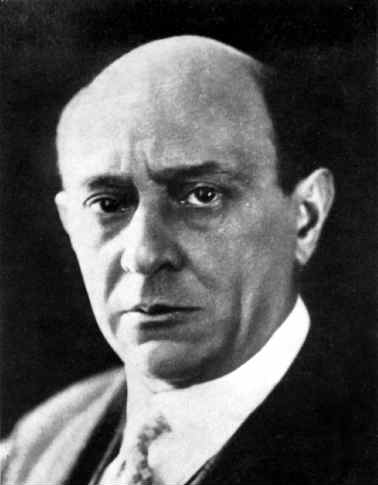
 Today's composer of the day is Alban Berg.
February 9, 1885 - December 24, 1935
(Photo: Alban Berg as played by Christopher Walken.)
Today would have been the 125th birthday for Mr. Berg, if he'd only had superhuman immortality. Berg represents Part II of our three part Composer of the Day! series on Second Viennese School composers. (see Part I here)
Berg was born into wealth, and died in poverty, the latter due to blacklisting by the Nazis. After knocking up one of his family's servants at age 17, Berg did the practical thing and got a job as a bookkeeper. By the age of 19, though, Berg did the unpractical thing and started to study composition with Arnold Schoenberg.
Berg is perhaps best known as the composer most-often cited by twelve-tone apologists and by haters of modernist music in need of some credibility. This is primarily due to Berg's reputation as a composer who successfully combined the musical sensibilities of Romanticism with Expressionist ideals and post-tonal musical languages.
Berg also ascribed to a system of composition that ventured to compose entire works of music from a single motive or musical gesture. This conservation of ideas manifests itself in many of his works, including the musicologist's wet-dream Lyric Suite, of which the first movement, for example, is derived entirely from a series of intervals in the very first bar. His most famous works are probably his Violin Concerto and his two operas, Wozzeck and Lulu. Both operas are touching stories of hope and the unwavering human spirit; the former about a soldier driven insane by doctors who then stabs his mistress, and the latter about a woman who kills her husband, kills her doctor, becomes a prostitute who is in turn killed by Jack the Ripper.
Here is a small bit from one of my favorite moments of Lulu:
Like his serialist comrade, Anton Webern, Berg suffered a rather tragic and gruesome death when he was (likely) bitten by an insect and died of blood poisoning, worsened by a little home surgery performed by his wife. He died on Christmas Eve, which, of course, totally sucks.
In the unlikely case that you haven't heard his music, please remedy that immediately. His music is a marvel of carefully executed musical architecture, and of lyrical and emotional depth.
Besides the already named works, his Chamber Concerto (1925) and Altenberg leider (1911-12) are amazing pieces more than worth the listen.
Chamber Concerto (1925), mvt. 1:
Five Orchestral Songs on Postcard Texts of Peter Altenberg, Op. 4 (1911-12):
-----------------------------
"I think the origin of all this clamour for tonality is not so much the need to sense a relationship to the tonic, as a need for familiar chords: let us be frank and say "for the triad"; and I believe I have good reason to say that just so long as a certain kind of music contains enough such triads, it causes no offence, even if in other ways it most violently clashes with the sacred laws of tonality."
-- Alban Berg, quoted in Reich, Willi (1971). Schoenberg: A Critical Biography, p.34.
2/9/10
Composer of the Day!
4/16/09
Your Iatrophobia Is Showing
Subtle is thy hand, for a serialist shall’nt love receive. Amidst a tasteful amount of gushing over some waltz by Strauss Junior and a Bruckner symphony, this:
[Berg’s Violin Concerto] explores the variety of emotion available to 12-tone compositions...
Subtle, indeed. Did you catch Tennessean critic Jonathan Neufeld’s slight jab, suggesting that there’s a limitation to the variety of emotion inherent in the 12-tone technique?
While it is not conclusive that the above is anti-serialist, there’s this one, which refers to the Laura Turner Hall’s fantastic acoustics for Bruckner’s music:
The same could not be said of the intensely expressive but intricately detailed Berg Violin Concerto. [italics mine]
Expressive BUT intricately detailed? Not sure what Jonathan’s going for—we’ve seen over and over serial music panned for its complexities. So it makes sense to think that Jonathan is implicating Berg’s intricate details as the main culprit, derailing what was otherwise a perfect acoustic display.
On the other hand, a wet hall might not be the perfect condition for the concerto. In my experience, this hasn’t been a problem. So I’ll leave that one in the air.
However, this might prove conclusive:
Berg's orchestration conspired to keep violinist James Ehnes from being heard as clearly as he might have been in a drier, more clinical, hall.
Oh, I get it! So, the orchestration ruined the performance.
See, it couldn’t have been the performer:
Nevertheless, he drew a pure, sweet and full tone, especially in the upper registers, that was a genuine pleasure to hear.
It couldn’t have been the new hall’s acoustics—Bruckner shines there:
Bruckner's huge sonorities and broad-brush Wagnerian drama, along with exposed but clear and full-voiced wind ensembles, come off extremely well in the richly toned Laura Turner Concert Hall.
So it must have been Berg’s orchestration, which requires a drier (don’t forget, serialism is erroneously synonymous with dry), more clinical hall (read: a sterilized operating room), because, as we all know, serialism is emotionally unavailable even if it is intensely expressive.
Like dermatological surgeons.
Graph 1. A place for skin graphs and serialism
-
4/30/08
Obligatory Anti-Serialist Post of the Week
Oh, inherent bias, what would we do without you? Welcome to Miami, dear readers.
In their contrasts, Franz Schubert and Alban Berg make a complementary pair.
Fair enough, I suppose. Contrasts compliment. Is that really quirky? This is quirky. Pairing two composers from the same city that lived less than a century apart seems more like…contrast, or complimentary. You said that. In your first sentence.

Both composers were, in very different ways, intrinsically Viennese and each man died young -- Schubert, most tragically, at 31.
Is dying at 50 (from an infected abscess from a bee sting) really less tragic than dying at 31? I mean, I suppose, maybe. Both tragic, though.
Schubert's genius added harmonic complexity and metaphysical angst to Biedermeier-era complacency.
Interesting sentiment. Note, however the construction: Schubert = genius. Let’s see what happens next!
Berg's lyricism and emotional depth put a human face on the chilly serialism of the
Ah, the inevitable backhanded knock on serialism. Schubert = genius. Serialism = chilly. Berg = mediates chilliness with warm emotion and lyricism. Not genius, though. That's reserved for pre-1900 composers.
Michael Tilson Thomas's smart, quirky programming combined works of both men for a bracing weekend Viennese festival by the New World Symphony. Friday night's opening event at the Lincoln Theatre set the tone with Berg's Lyric Suite and Schubert's Mass in E flat.
Mr. Johnson’s review of the Schubert can be read via the link at the top (and it's perfectly cromulent). I am only concerned with the inherent bias about…
Berg remains the most passionate and directly communicative
Passionate! Communicative! Emotional! Lyrical! Fuck that chilly non-genius Schoenberg! He totally didn’t write Pierrot Lunaire (which, in all fairness, is pre-12-tone, but also passionate, lyrical, emotional, and communicative all the same).
of the 12-tone school's early triumvirate (Schoenberg and Webern, being the other two).
You don’t say. And, what’s with, the, comma?
His Lyric Suite was born of an impassioned but apparently unconsummated love for a married woman.
So they say! What else?
Though written in 1928, Berg's Lyric Suite breathes an atmosphere of findesíecle
Although this could be an internet publishing error, someone should proofread these things. Fin de siecle (while I appreciate the italics) is totally ThreeDifferentWords.
Though written in 1928, Berg's Lyric Suite breathes an atmosphere of findesíecle Viennese decadence, the world of Gustav Klimt and Thomas Mann.
Even though…what? Thomas Mann: 1875-1955. Won the Pulitzer in 1929, the year after this particular Berg piece was published. Completely contemporary. Klimt died in 1918, but is still roughly contemporaneous with Berg and Mann. For no real reason, here is a picture by Klimt that is fun to look at.

The romantic inspiration is clear with its Tristan quotation but Berg deftly creates a kind of wrong-note Mahler, fusing subdued tragedy and emotional intensity within serial strictures.
Wrong-note Mahler. Seriously? Crap. (deep breath)
Berg wrote wrong notes!? What a lyrical emotional passionate chilly fool. Those damn serialists! They had no fucking idea.
The sense of romantic yearning and dark foreboding was clearly palpable in Friday's performance under Tilson Thomas. The burnished strings brought out the angular music of the opening movement as much as the mystery and elliptical strangeness of the multi-divided strings in the central movement and the dark-hued somber valedictory of the final section.
To sum up: Berg’s Lyric Suite is lyrical, passionate, emotional, and communicative, which mediates the cold chill of his technique of writing wrong notes, but is still angular, foreboding, elliptical, and dark-hued.Whee!