9/22/09

Interchangable Prepostions; Dead Editors

It's delightful, occasionally, to peruse some of the smaller papers' reviews. Also delightful is encountering the fanciful names of said papers; in this case, the Steamboat Pilot & Today.

This puff piece was, really, just fine. It could've used the light, deft touch of the practiced pen of someone perhaps accustomed to tidying up the quickly composed prose of feature writers. Oh, if only such a position existed!

But, really, all prepositions being equal...

Orchestra inspired in opener, Margaret Hair, Steamboat Pilot & Today

A trio of solo performances from...


by?

...from guest violinist Stephanie Sant’Ambrogio and a spirited rendition of Beethoven’s Symphony No. 4 made for a smooth opening night

(Passive voice, but whatever.)

for the Steamboat Springs Orchestra’s 2009-10 season Saturday at Strings Music Pavilion.

Also, a delightfully named Pavilion!

Sant’Ambrogio and her father, John, who is the orchestra’s principal cellist, started the program with their first public performance of Vivaldi’s Concerto in B-flat Major for Violin, Cello and Orchestra.

[I'd omit "who is" as unnecessary, but I don't get paid by the word. Er, or at all.]

The orchestra [was?] appropriately laid back for most of the piece, lightly complementing the Sant’Ambrogios’ natural similarities in playing style.

"Natural similarities" of father and daughter? Sounds more like "nurture." Is string technique inherited?

There aren’t too many hints on how loud to play and when...

"How loud to play and when"? Er, dynamics? Also: "hints on"?

I can understand not wanting to saddle the unwashed, ignorant masses of Steamboat Springs, Colorado with a bunch of Super-Technical Music Jargon Words, but let's give them a little credit. Or better, a little prose style.

...in the classical sheet music of Vivaldi’s time;

Worst. Phrase. Ever.

that had no impact on the easy interchanges between the featured violinist and cellist, who gave a seamless performance.

The lack of dynamic markings didn't hinder the soloists' interpretation? A breakthrough in Baroque performance practice!

On...

On? In?

On Franz Schubert’s Konzertstuck in D Major for Violin and Orchestra, Stephanie Sant’Ambrogio gave a strong interpretation

Okay. Good enough, but where's the period indicating that...wait, there's more sentence?

...of the classical piece.

I guess there really wasn't more sentence. Huh.

For...

For?! (In? During? Throughout?)

For Fritz Kreisler’s Tambourin Chinois, the guest soloist breezed through the choppiest patches of the virtuoso piece...

Virtuostic? Adjective?

with what seemed to be technical ease.

As opposed to metaphorical or allegorical ease? Interpretive ease?

While the first part of the program was solid, the biggest wave of energy on the night...

I like (honestly!) that the first part of the program was solid, and the second a wave (probably really a particle/wave) of energy.

While the first part of the program was solid, the biggest wave of energy on...

...of?...

...on the night came with...

During?

...with the last movement of Beethoven’s Symphony No. 4, a section SSO Music Director Ernest Richardson described in a program break as pure joy.

But not as "pure joy," I infer.

The rest of the group must have agreed, offering a rendition of that...

...the?...

...that last movement that filled the Strings Music Pavilion with sound for the first time in...

During?

...in the concert program.

The rest of the program was silent? Pantomimed?

Richardson has a definite gift for giving the audience access points to classical music,

"Access points?" Okay.

...and he did that with quick, sometimes humorous descriptions of each movement in...

...of?

...in the symphony.

*deep breath*

It gives the listener something to look [listen?] for and hold on to,

Er...

...and reminds the audience that classical composers had more interesting inspiration to...

To? Uh...for, maybe? Or maybe not. What-

...to their music than we might remember.

I don't know what that means. I'm not sure if that sentence means anything.

What is it assumed that we "might" "remember" "classical composers" "had interesting inspiration" "to"?

Gaah!

With each concert, the Steamboat Springs Orchestra shows its ability to tap into more and more of that inspiration.

Whew.

Normally, I'd probably leave out the "for more information, go to..." tag, but this one contains a hidden gem!

The group has three more concerts with $20-per-person advance ticket prices and two fancier soirees scheduled for the season,

Must...not...point out...missing accent...italicize...foreign words...gnnnnh...

...with classical repertoire standpoint pieces such as Dvorak’s “New World Symphony” and Mozart’s Symphony No. 40 on the program lists. For more information about the 2009-10 season, go to www.steamboatorchestra.org.

"Classical repertoire standpoint pieces" is totally the name on my new punk band ensemble that I just imagined in to my head.

It's late, so here is a picture that is fun to look at:

Figure 0: Robert Fulton's Claremont, ?ca 1807

9/17/09

Just Because You Write for the Times Doesn't Mean You Don't Suck

Joe Queenan, Two Great Tastes (but Not Great Together), 9/6/2009, New York Times

Let's get right to it.

ON Sept. 12 Trey Anastasio, the lead guitarist of the jam band Phish...

Whoa! Hold it there, maestro, you almost lost me. Phish is a jam band? Good thing you qualified that for me, because, see--I just popped into being like 8 seconds ago. Maybe you can help me: what's this thing dangling between my legs?

ON Sept. 12 Trey Anastasio, the lead guitarist of the jam band Phish, will give the New York premiere of his concerto “Time Turns Elastic” with the New York Philharmonic at Carnegie Hall.

I guess that I assume that Anastasio wrote a concerto for electric guitar and orchestra, and I also guess that I assume that he's playing the solo part and not, say, conducting. But I don't know. Because: you did not provide this information. Instead, despite a hyperlink [in the online version, of course], you elected to report [sic] that Phish is a jam band.

If earlier versions available online are any indication, Mr. Anastasio will be bringing New Yorkers not some gaseous reimagining of Carl Orff’s “Carmina Burana” or Gustav Holst’s “Planets” — the route pop classicists usually take — but a recognizably Anastasian composition rooted in the style that made Phish so successful.

Ugh.

First: Titles of entire compositions should be italicized. If you're going to be--or pretend to be--a cultural elitist asshole (which is evident, in abundance, below), get it straight, or you'll look like an idiot.


Figure 1: Just a suggestion.

Second: Hey, mister editor at the New York Fucking Times? See above, and do your job.

As such, it is bound to be an improvement on what these escapades in cultural alchemy usually turn into.

Hey, asshole/idiot guy who writes words for a living? Your bizarre subjunctive-speculative sentence ends in a preposition. Again, a tip: if you're taking the cultural high ground (as it were)--or (again) perhaps, pretending to--try to follow basic rules of usage.


Figure 2: More of a necessity than a suggestion.

Okay, now, let's calm down. Maybe I'm being too harsh...?

Classical ensembles have been slumming with rock stars since the days of Frank Zappa.

Or not.

Hey, asshole? Go fuck yourself and your faux-elitist sensibilities.


Figure 3: "Most people wouldn't know music if it came up and bit them on the ass." --Frank Zappa

Anyone who really thinks (or, worse, says in print) that Frank Zappa was a "rock star" and/or that "classical" ensembles were "slumming" with him by association (no matter how tongue-in-cheek that remark was meant) is a moron of the highest caliber. Besides demonstrating a complete ignorance about what Zappa thought about, well, anything, but particularly music, it utterly misunderstands his relationship with so-called "high" and "low" art.

Moreover, singling out Zappa for this faux-slur is perhaps the second dumbest example you could have chosen, right after John Coltrane.

Figure 4: Unsophisticated pop musicians are best served avoiding pretensions of intelligence.

Bop and serialism were, in the late fifties and early sixties, aesthetically pretty close to one another. Further, not all "rock" music was made by idiots in their garages. "Real" or "trained" rock [pop] musicians making sophisticated and/or intelligent music did not begin with King Crimson. And minimalism deliberately blurred the "uptown" and "downtown" scenes; and Paul McCartney was listening to Stockhausen far before Sgt. Pepper was recorded.

Oh, but clearly, Queenan's an expert on both "classical" and "rock" music and/or culture in general. I assume this because his writing appears in the Times (evidence follows).

This year alone the Decemberists have performed with the Los Angeles Philharmonic and with a pickup orchestra in Chicago; the classical pianist Christopher O’Riley is offering tarted-up versions of songs by Radiohead and Nick Drake; and, most ominously, Sting is giving onstage readings of the letters Schumann wrote to his wife, Clara; meanwhile a pianist in the background plays Schumann.

Oh noes! My hegemony is being threatened! HALP!

Also: how is that last bit "ominous?" It portends the arrival of...your scorn?

Also: was there really no way to compose that last clause without using "Schumann" twice?

Figure 5: Pretty much the same thing as this article.

No matter how much of this cross-fertilization goes on, there is no evidence that it takes root with the target audience.

I assert that this is totally untrue, partially because people keep doing it, and it must make some money somehow, or they'd quit. Moreover, your evidence for there being "no evidence" is comprised, both merely and utterly, of a bunch of baseless assertions.

Young people are not drawn to the classics by listening to rock stars moonlighting on their day off,...

Evaluation: baseless assertion. Is that an observation? Is there a study of some kind? Did you read it in a book?

No?

No. You decided it, and wrote it. Well done.

...or by hearing Béla Fleck jack up Scarlatti on the banjo.

Again: baseless assertion. Also: "jack up"? I don't think this is an accepted use of this slang-y term. Who do you think you are, Jim Rome?

Figure 6: "Dude. Bro. Get that clarinet out of your grill and use your dome."

Can we just fucking say any bullshit that comes into our head, and, despite any supporting evidence (or lack thereof), get our mental Pablum published in the goddamn New York Times?

And classical audiences tend to loathe intruders: this is a genre whose enthusiasts initially turned up their noses at George Gershwin.

And then decided he was a genius. Also, there used to be a sign over the door in Symphony Hall in Boston that said "In Case of Brahms, Exit Here," but they figured it out. Also, Beethoven's early critics thought he was writing noise instead of music, which was (also) almost verbatim, the exact criticism leveled at Shostakovich.

The evidence does not support your, uh, "thesis." Moreover, your evidence is for crap. Moreover, your thesis is for shit.

Oh, but here comes the money quote!

So they’re not likely to welcome the guy from Phish with open arms. And in any case, reading David Baldacci doesn’t lead anyone to “David Copperfield”; it leads to Dan Brown.

Holy crap. Seriously? What?

Really?!

Oh jesus christ on roller skates...

Basically, Queenan has just erected an iron wall between "high" and "low" culture, regardless of the interrogation and scrutiny that this distinction has been under since, for instance, the twenties.

That is at once both the most ignorant and most offensive thing I think I've ever read regarding music.

There's more to the article. Well--there are more words in the article.

But I don't care. I'm fucking done. Read the rest if you want. I'm out.

I'd rather fuck a bag of razors* than pretend this is worth a pile of gerbil shit.

[leaves]

*Yeah, thanks. I spent a while coming up with that one.

9/15/09

Off Topic

Susan said...

I recently came across your blog and have been reading along. I thought I would leave my first comment. I don't know what to say [sic] except that I have enjoyed reading. Nice blog. I will keep visiting this blog very often.

Margaret

http://businesseshome.net [no hyperlink intended]


Table 1.35: Hey Susan, who the fuck is Margaret?

Twitter is Destroying Classical Music...

Are critics really allowed to do this...attack the soloist? Don't they know that it's their job to heap excessive amounts of hyperbolic praise upon every soloist who ever plays with an orchestra? Guess not. Anyways, good, it's nice see critics turn that scornful ear towards something other than new music.

So I was a bit curious when I came across this article in the New York Times, by Michael Kimmelman, that seemed to be a pretty scathing review of renowned pianist Lang Lang after a performance in Lucerne, Switzerland.

However, hell if I know what Lang Lang did wrong.


figure 2: Lang Lang auditioning for remake of Thriller video.


Racing Chopin All the Way to the Wire

The other night Lang Lang twittered his way through Chopin’s F minor Piano Concerto.

Twittered? Tweeted? Anyways, Lang Lang posted 140 character messages online throughout his performance of Chopin? Really? That's pretty amazing.

How better to describe it?

Good question. Well, you chose the verb "twitter" which basically means (as our good friends at dictionary.com can attest): to utter a succession of small, tremulous sounds, as a bird; to talk lightly and rapidly.

You were there, does that sound about right to you? And if so, what kind of first line of a review is that?

The other night Lang Lang lightly and rapidly played his way through Chopin’s F minor Piano Concerto.

That may be true, but it's hardly a compelling first line. Are we preparing for a negative review...of a soloist?!? Wait, is "rapidly played" even an insult?

I'm not sure what to make of it. Although, my high school creative writing teacher would not have approved of that bland "the other night" introduction. That doesn't set much of a stage now does it -- I mean, you're in Lucerne, Switzerland. Not exactly just another night to most of us. Set the mood, use a little pizazz. May I suggest:
"The night was dry, yet it was raining", or
"The night was sultry"...no, too parochial...how about...

The sultry moonlight beamed stealthily down between the sprawling peaks of Mount Pilatus and Rigi upon the intertwined corpses of twin artisan dairymaids from Olten-Zofingen, and Lang Lang lightly and rapidly played his way through Chopin's F minor Piano Concerto.

Nailed it. Moving on...

He played with the Dresden Staatskapelle under Fabio Luisi at the KKL concert hall here. I can’t recall a more galling soloist. [italics mine]

Ouch.

Another interesting word choice, but I think we can forget any uncertainty over the meaning of "twittered" -- galling doesn't leave much room for interpretation. Offending, vexing, irritating, and grievous are all synonyms.

So, Lang Lang gave an offensive, irritating performance through his rapid, perhaps even frivolous playing. Nice introduction, how to you plan to support this thesis...

Lang Lang, the 27-year-old Chinese virtuoso, is by various measures the most popular pianist around, a kinetic superstar thanks to his outsize charm and gymnastic technique that earns him the nickname Bang Bang. He can play with grace too. He didn’t here.

Graceless. Check.

He splits opinion.

Others have criticized his playing as well. Got it. But do continue...

He splits opinion. Contemporary culture in general is polarized, but the poles keep shifting in ways that can help tell us where we are.

Huh? The poles of polarized contemporary culture (or is that opinions) move in ways that help us tell where we are?

I've read that sentence probably a dozen times now, and I'm still not sure what it says. How about an illustration...


By way of illustration, the night before Mr. Lang made mincemeat of the Chopin concerto, a sizeable, rapt crowd listened in the same hall to Pierre Boulez conducting works by Janacek, Varèse and Berg.
figure purple: Chopin's f-minor Piano Concerto after a Lang Lang performance.


There have been Lang Langs for as long as there have been keyboard players. Showmen in different eras touch different chords for different generations.

So true. Many a wonderful showman have graced the stage with a piano, like this guy...

figure 3: Entertainment at a fundraiser for the RNC

This is the age of instant messaging, sound bites, of atomized culture, with information packaged for our convenience in morsels, and Mr. Lang is embraced for more than his winning smile and playing very, very fast.

O-kay...? This is the age of instant messaging.... Um, good point?

Instant messaging = liking people for their smiles?

The way he took apart Chopin’s score made it into a jumble of hyped-up anecdotes.

So, inspired by modern culture, he jumbled up the score? Or "atomized" the music into "morsels"? Did he leave something out? Play only the major themes and the rest is just treacle?

I must say, Mr. Kimmelman, you have me very confused. Moving poles, twittered playing, atomized culture...I'm beginning to think that you didn't like his performance.

So what exactly didn't you like about it?

Here he played super quietly, there super slowly, there like Wile E. Coyote in his Acme rocket shoes.

figure ∞: Lang Lang playing Chopin's f minor Piano Concerto, just before he smashed into the side of a cliff.


Occasionally he came to a near standstill, forcing the orchestra to crawl with him, so he could ravish a rubato. He swooned and swayed as if possessed by the music (feeling the music “at you,” to borrow the New Yorker magazine critic Alex Ross’s phrase), as if the audience needed little parcels of exaggerated emotion and virtuosity to stay interested.

To recap, you don't like too much gerrymandering with the tempo. Yes, that can be distracting.


So, what about those moving polarized poles, and the reference to an atomized culture?

It brought to mind what Anne Applebaum, the Washington Post columnist, wrote about interpreting history these days.

Wait, what? You were listening to Lang Lang play Chopin, and Anne Applebaum and her comments about interpreting history came to mind?

Yes, non sequiturs are fun.

Writing for The New Republic, she reviewed a book by Nicholson Baker, “Human Smoke,” about the lead-up to World War II, which stitched together, without comment, hundreds of nuggets culled from newspapers, memoirs and other (often secondary) sources to suggest a case for pacifism.

Interesting. Okay, the connection is slowly becoming less incoherent. "Hundreds of nuggets" = "atomized culture...packaged for our convenience in morsels"? Am I close?

“A series of pretentious, Gawker-like vignettes,” Ms. Applebaum called these orchestrated tidbits. “Ripped from their respective contexts each item has the same weight as the next. There is no hierarchy, no sense that one enigmatic anecdote might be more important than the next equally enigmatic anecdote.” That’s not a bad description of what Mr. Lang did with the Chopin concerto.

No wonder Lang ruined Chopin, his out-of-context arguments gave false pretext to World War II. Wait a minute, is that true? You're going to have to bring this one all together for me, Mr. Kimmelman.

What Ms. Applebaum added is also true about music: “There are many legitimate ways to write history, even many avant-garde, nonlinear, novelistic ways to write history, as the historiography of World War II itself well illustrates.” But history persuasively told, like music interpreted, comes down to cogent arguments.

Is "history persuasively told" really the same thing as "music interpreted"? Okay, I think we made need an example.

The pianist Glenn Gould was an eccentric interpreter, but his interpretations, whether you liked them or not, had their own internal, neurotic logic. They made an elaborate case for themselves. The same could be said about playing by Vladimir Horowitz or Sviatoslav Richter.

How is one interpretation cogent, and another not? I suppose you're suggesting that Lang Lang's interpretation is not logical?

Flashy passages strung together don’t make an argument.

Right, an argument is a connected series of statements intended to establish a proposition.

They make an assortment of fetishes.

figure 6: Figure 6 has been removed due to "legal advice".

Flashy passages are not an argument, but they are an interpretation? So, a performer should not interpret, but argue? Or is it that they should first interpret and then argue using their interpretation?

“Perhaps,” Ms. Applebaum wondered at one point about “Human Smoke,” “the whole book is a gigantic practical joke, a stunt intended to provoke.” I wondered the same thing during the concerto.

Perhaps you should have started this review off with, "You had to be there," because I don't get it.

You thought that this performance may have been a joke? Because it made a bad argument? Actually a non-argument because he interpreted the music in small Twitter-sized capsules?

I decided it was a stunt. But it wasn’t a joke. Whatever else he may be, Mr. Lang is sincere. He has peddled his sincerity all the way to the bank.

That doesn't sound sincere at all. In fact, that sounds like you're suggesting he's faking sincerity for financial gain.

That and his virtuosity, so his fans say, have made him classical music’s latest matinee idol.

The question is what does his playing say about us.

So many questions unanswered. I am loathe to try and summarize this mess, but here's the short short version:

Lang Lang plays too fast. And he writes bad history because he plays music in random, unconnected, yet enigmatic tidbits with no hierarchical structure.

----------------------------------

Seriously? I love a good evisceration, and I don't necessarily doubt the validity of the critique I think that Kimmelman is trying to make, but wow, could he have found a more convoluted analogy to make?

9/10/09

Critic speaks, then listens...

Here, Charles Spencer, of Telegraph.co.uk, gives us his impressions of music and art at a festival in Edinburgh. Of note, Spencer is the theatre critic for the Telegraph.

Charles Spencer's Diary

One of the great things about theatre is that it has largely escaped the twin curses of modernism and abstraction. Ionesco’s plays may be reminiscent of the paintings of Magritte, and Beckett distilled drama to its essence, but, even in these instances, the very fact of having actors on stage, words spoken, and an audience watching creates a feeling of common humanity. The theatre is still a place we go to listen to stories and learn about the world and ourselves.

Translation: Being familiar with modern theatre, I appreciate the more adventurous contemporary playwrights for their contributions to the art.

In contrast, the wilder shores of modern art and contemporary classical music seem far more daunting. Both are elitist in the sense that they rejoice in complexity and obscurity for their own sake, and appear not to give a damn about the audience, except for a coterie of admirers.

Translation: However, being unfamiliar with contemporary classical music and composers, their innovations are wrong. It is music written by jerks to be admired by snobs.


More recently, with the Brit Art explosion, we have also witnessed an adolescent desire to shock merely for the sake of it.

Sure, why not. A few examples of Brit Art (or Britart), works by young British artists:


figure 1: Snowman, Gary Hume

figure 2: My Bed, Tracey Emin


figure 3: The Physical Impossibility of Death in the Mind of Someone Living, Damien Hirst


figure 4: Attempted Birdhouse #1, H. J. Simpson

Now, I don't mean to begrudge Mr. Spencer his opinions, nor his jabs (although, "adolescent" is probably more incendiary than informative, don't you think?). However, Spencer basically admits that he's unfamiliar with this music and art, and while not fully understanding it, he seems perfectly happy to characterize it (and the people who listen to it) with broad stereotypes and generalizations.

I wonder if he would be as forgiving of someone (especially someone who is a position of a authority, like say...an art's critic) who dismissed plays and playwrights with prejudice and insult.


However, this is his "diary" entry. He's being honest with us, blunt even, and that's something I do appreciate.

I was becoming a bit of an old fart about all this, so in Edinburgh at the tail end of the festival I tried to put my prejudices aside and look and listen with an open mind.

Check. Now that you've minimized new music and its audience, let's get on with the review...

I booked for two concerts by the Arditti Quartet, which has given the premiere of several hundred modern string quartets and other chamber works, by the daunting likes of Harrison Birtwistle, John Cage, Elliott Carter and Karlheinz Stockhausen.

At first I though the reference to "several hundred" premieres was some sort of flip remark -- but sure enough...second sentence of the wikipedia entry for the Arditti Quartet reads just that. Wow, they've been productive.

And, oh, thanks for "daunting".

I also trekked along a delightfully umbrageous path by the Water of Leith to the Scottish National Gallery of Modern Art.

I like this turn of phrase here -- "delightfully umbrageous path".


Is there a chance he meant umbrageous by it's alternate meaning of "irritable"? Nah.

I won’t pretend I liked everything I saw and heard.


We would expect nothing less. I certainly wouldn't pretend that...well, unless the composer was in the room.

Ligeti’s String Quartet No 2 left me fuming as the violinists wasted much of their time imitating the whine of a mosquito, and Andy Warhol still strikes me as a brilliant charlatan.

Ligeti's String Quartet No. 2 -- although, not the Arditti Quartet.

I guess it sounds like a mosquito -- I think it sounds more like "ants eating my face".


But there was far more that I enjoyed and that left me stimulated.


In the Artist Rooms exhibition at the modern art gallery I suddenly began to see the point of Damien Hirst, sheep in formaldehyde, pharmaceutical packaging and all.

...(see the shark in formaldehyde above in figure 3)...

Far from being the shock merchant I’d taken him for, he is essentially in the serious business of creating beautifully crafted memento mori in an age when most of us prefer to forget that we are mortal.


Translation: Mea culpa. My bad.

By the way, excellent reference there with the "memento mori".

The Arditti Quartet performance of Schoenberg’s String Quartet No 2, in which he “finally allowed his music to float free from the binding force of tonality”, and a soprano sings, “I feel the air of another planet” as if announcing her arrival in a new world of music, still seemed strikingly modern, strange and beautiful more than a century after its turbulent premiere in 1908.


Isn't this the same music that rejoiced in its complexity and obscurity? But yes, it does sound strikingly beautiful.

However, while trying to praise this Schoenberg work, Spencer can't help but bring up the famous anecdote that follows below, often used to illustrate how justifiable it is to disdain new music.

On that occasion a leading critic stood up and shouted: “Stop it! Stop it! We have had enough.”

One of Schoenberg’s pupils recalled: “It was then that people forgot their drawing-room manners. Part of the audience joined the riot which others tried to silence. Not much of the music penetrated the noise.”

I will commend Spencer, however, for not going so far as point out that this is the infamous work that killed tonal music. It was this string quartet that Schoenberg was writing when he discovered his wife was having an affair with the painter Richard Gerstl. So overcome with grief and rage, that despite the first few movements being composed with distinct tonal key areas, the affair pushed him over the edge. Schoenberg rejects tonality in favor of the devil's atonality for the final movement, and subsequently for the rest of his musical career, thus ruining classical music forever.

At least he didn't tell that story...but this tamer one is still just as irrelevant to liking the piece.

Why print that anecdote here? Come on, Spencer, you've just, in the course of only a few paragraphs, had an awakening.

You started us off with the premise that unlike modern theatre, contemporary music is obscure and overly complex -- but you ended up liking some of the music. Can't you revel in that for a little longer? Maybe the music isn't as obscure as you thought it was? Or perhaps complexity doesn't equal elitist? ...

Anything?

After my crash course in contemporary music and art, I hope that, in similar circumstances today, I would be on the side of those trying to allow the shock of the new a fair hearing.

Translation: It helps to hear the music before judging it.

------------------------------------------
Why must we always start with the opinion that new music is something awful and weird...something to be overcome, rather than reserving judgment until experienced in earnest on one's own? I realize that this narrative about new music is all to commonplace in our culture, but why should it continue to dominate...? Why should critics (people who should know better) repeat that same uninformed bias, even when ultimately recommending new music?

I'm glad Spencer considers himself a convert. But seriously, the lesson here is that
it's too often the case (with the arts) that all opinions are considered justified, no matter how uninformed.

9/4/09

"Galaxy nearly destroyed," says local scientist...

"...The encounter could create a time paradox, the results of which could cause a chain reaction that would unravel the very fabric of the space time continuum, and destroy the entire universe! Granted, that's a worse case scenario. The destruction might in fact be very localized, limited to merely our own galaxy."
Doc Brown, Hill Valley, 2015


So, John Daly-Peoples, of the National Business Review, writes a preview of the performance of Mahler's Sixth Symphony by the Auckland Philharmonia.


figure 1: A different John Daly playing a little shirtless golf. Not fun to look at.

MAHLER'S TRAGIC TALE

This week the Auckland Philharmonia will be playing one of the first and probably the greatest autobiographical symphony of the twentieth century with Gustav Mahler’s sixth symphony.

Autobiographical symphony? Okay, I guess. Premiered in 1906, and sometimes know by the editorial title "Tragic Symphony", many historians, and even Mahler's wife have made overtures of the autobiographical meanings in the work.

However, Mahler was seemingly at a happy point in his life, having recently married Alma Schindler and enjoyed the birth of a baby daughter during the composition of the piece...but hey, I didn't know the guy, perhaps it was inner torment.


But I digress...

Beethoven’s great symphonies portray mankind in a heroic manner. He attempted to show man in pursuit of higher aims but they were figures of almost mythic proportions.

I guess it is true that you can't write about Mahler without mentioning Beethoven...

Mahler on the other hand puts himself at the centre of the music with the music expressing his own fears, emotions and aspirations.

Like the contemporary thinkers such as Sigmund Freud he was endeavoring to find the universal truths from within the individual.


Composed in the early years of the twentieth century the sixth symphony...

wait for it...

Composed in the early years of the twentieth century the sixth symphony presages the tumultuous world evenmts [sic] to come.

The symphony does what now? Presages? So it's not just autobiographical, it's a fortune teller?


figure B: Who knew?

Is Mahler not aware that having knowledge of the future could possibly screw up the space-time Continuum and endanger his own existence?


figure trois: "Marvin, you gotta play. See that's where they kiss for the first time on the dance floor. And if there's no music, they can't dance. If they can't dance, they can't kiss. If they can't kiss they can't fall in love, and I'm history. "

And oh, "evenmts"
?

It also prefigures the calamities which would afflict the composer; the death of his daughter, his loss of prestige in being dumped from the Vienna Sate Opera and his being diagnosed with a terminal heart condition.

Damn. I wonder how his fate would have been different if he had just added more cowbell?

Are we not at least a little surprised that Mahler had supernatural powers? Is this common knowledge -- Mahler gazed into the future and wrote a symphony about what he saw?

Guess so. Although, to be fair, in the original program notes Mahler added this little anecdote that may illuminate his omens of doom in the work:

"Last night, Darth Vader came down from planet Vulcan and told me that if I didn't take Lorraine out that he'd melt my brain."


figure 4: Darth Vader presages tumultuous world events to Mahler.


----------------------

From now on, when writing and thinking intellectually about music, can we agree to seek out rational explanations for the underlying story behind a piece of music rather than to attribute mystical powers? Thanks.


9/3/09

Bad Advice

So. The Guardian UK is holding a young critic's competition (again).

Figure 1: Hard at work on a Stockhausen critique, a young critic thoughtfully selects the orange pencil to signify hope.

Well, first: I lied. The deadline for submissions has passed; the winners (and their work) have not been announced.

No, I'm not taking this opportunity to lambaste some poor teenager's prose. (You're the jerk for even thinking that.)

Figure 2: Navin R. Johnson

What, then, am I on about?

(Besides the delightfully absurd and annoying entry form.)

Hm.

Fancy yourself as a critic?

Doesn't matter; I entirely fail to qualify, as I am not under 18, British, or proximal to a time machine that'd let me get my entry in before last Friday.

(And no: I most certainly did not submit a fake entry. I can't believe you people would even think that.)

Think you've got what it takes to be a critic? Send us a review of between 300 and 350 words of an album, film or concert that inspires – or disappoints, or – annoys – you this summer.

M-dashes are on the what now?

We'll be judging the competition in eight different categories: film, pop, visual art, theatre, TV, classical music, dance and architecture.

Parsing these categories would be fun (architecture but not books? Pop is assumed to be music, but there's no "classical" category except music?), but ultimately not amusing enough to spend time and space on right now. So I'll go for the easy joke instead:

Y'all spelled "theater" wrong.

Figure 3: "Oh no, the sink's clogged! Call the plumbre!"

Our judges – who also include architect Will Alsop, choreographer Hofesh Shechter, and chair of Arts Council England Liz Forgan – will be looking for powerful, persuasive voices, with original opinions and a flair for expressing them. Each category will be judged in two age groups: under 14s and 14-18-year-olds.

That's fair enough, a solid all-around idea, and has some people from actual arts industries involved. What could possibly go wrong?

You should review something new or recent in your chosen category (though we'll make an exception for architecture, which can be new or old).

That's interesting: a new concert of old "classical" music counts as recent...but architecture is exempted. Again: really? Architecture? Not books?

[snip]

To enter, download an application form here...

They also had a contest for under-14-year-old form designers?

The deadline for entries is Friday 28 August 2009. You'll also find lots of useful information on the website here, including details of free and discounted events across the UK, a full list of this year's judges, last year's winning entries and top tips on writing a review from the Guardian's team of critics.

Good. Fine. Praiseworthy, even. It seems that...

Wait.

What was that last bit?

....top tips on writing a review from the Guardian's team of critics.

Ah. Better take a look at that, eh?

(I ask again: What could possibly go wrong? I mean, as long as they're "top" tips. Right?)

The judges offer their advice for all budding arts critics


Charles Hazlewood, conductor
Judge in the classical music category

(Charles Hazlewood's website)

Critics sometimes forget that they wield immense power.

Figure 4: An arts critic relaxes after a day of hard work. (The small box in his left hand contains the souls of recently maligned musicians.)

When, as an artist, you get a good review, you feel as if you're walking on clouds. But when someone writes a really damning review, you feel as if someone has slit a hole in your guts and pulled out your entrails.

Good reviews make you feel good. Bad reviews, conversely, make you feel bad. It sounds radical, I know. But hey, who's the barber here?

A good critic is aware of this.

Probably?

They are knowledgeable, thoughtful, reflective, but also compassionate. They recognise the important difference between expressing reservations about something, or even disgust, and being poisonous for the sake of it.

Okay, good. This seems like an excellent thing to keep in mind when attempting criticism. It is not exactly prescriptive, however, and therefore does not qualify as advice (that is: "top tips on writing a review").

What's your "top tip," Maestro?

The biggest single piece of advice I would give to any young person interested in writing criticism is to base your writing entirely on how the art makes you feel.

Guh?...Wha!?

That may be the single worst piece of advice I've ever read. And I read Altas Shrugged.

Feel? What happened to "knowledgeable, thoughtful, and reflective" here? Certainly the experience of (for example) going to a concert is not to be ignored; nor is the [perceived] emotional content or affect of art. But basing "your writing entirely [emphasis mine] on how the art makes you feel" seems like an awful idea. Especially, perhaps, for a novice.

If you have no prior experience or advance knowledge of music by, say, Stockhausen, or Cage, or Bach or Mozart for that matter, you might have expectations that are far different from what you'll experience at a concert. Relying solely and ultimately on how you "felt" about it is not useful to the reader, except, perhaps, in the way that it might be interesting to send an aeronautical engineer to judge a dog show.

Figure 5: The aerodynamics are all messed up, and it doesn't seem to have any wings whatsoever. I seriously doubt they'll ever get it off the ground.

What is the justification for this nugget of wisdom, Maestro?

The paper or website that hires you to write a review does so because they trust your judgment and your instincts; they don't want the received view.

That's fair, and actually helpful. But it doesn't justify entirely basing your review on how you feel.

Although, in a way, isn't part of the critic's function exactly to present, or at least shape, the "perceived view"? We wouldn't even have a "perceived view" at all.

But that's not really the point.

It's natural to want to move in packs, and you see little cabals of critics at some events, teaming up to base their opinion on what the others think. That's the worst thing to do.

Okay; I agree with this, too. And it's important to think for yourself, and think about art on one's own. The operative word, I think, is think.

Trust your own gut instincts; be open to the response a piece of work evokes in you, and then don't worry about what anyone else has said, before or after.

This, also, sounds good, even mediating or qualifying the advice given above.

Again: we should under no circumstances ignore our response to art on an emotional level.

Again: I realize we're talking about a Young Critic's Competition.

That's why it's so important to emphasize thoughtfulness and contemplation in addition to, perhaps even above, feeling. Advising a teenager to go with their feelings--above all else-- is like two pounds of puke in a one-pound sack.*

Figure 6: A teenager.
"That concert was stupid! My dad won't let me get my nose pierced! You're stupid! I hate you!"

*Thanks to my childhood next-door neighbor for this colorful, and apt, colloquialism.

9/1/09

Composer Thinks Outside the Box

Hello Dear Detritusites,

It is a real honor to be asked to contribute to The Detritus Review. Thanks to Sator Arepo and Empiricus for starting a much needed conversation on the public discourse of contemporary classical music, and I hope that I may be able to add to and help further the dialogue on this very smart, and often, very funny blog.

For my first post I had hoped to find a shining example of the educated and informed advocacy for new music to praise and perhaps shout a few amens. And luckily, those points-of-views were out there (and are worth a read).

--In the Buenos Aires Herald, Craving Dissonace! is nicely written argument, in part addressed to the performing organizations and classical music radio stations of Buenos Aires, asking for a little Cage and Stockhausen along with the Monteverdi, Mendelssohn and Mozart.

--And, Robyn Archer wonders why composers seem so anonymous over at The Australian, an online newspaper.

However, despite the advocacy by the two above articles, Canadian composer John Burke caught my attention.

Figure 1: John Burke, or so how I assume he looks.

Music with a holistic approach

Canadian composer John Burke is not interested in creating music simply to be listened to any more.

Wow! Music that can be tasted? Perhaps inhaled? Absorbed? Made sweet love to...?

Clearly, we can do lots of other things while listening to music. Some dance, others crumple programs, while others lose control of their bodily functions -- but John Burke has more in mind. Please, tell me more.

He wants to move people – emotionally, spiritually and physically – and more than that, he wants to empower his audience.

How exciting. If it's one thing that I've always felt was missing from music it was the emotional, spiritual, and physical aspect. Music has always been such a dead, lifeless form with no connection or history with religion or physical activies -- be it walking in unison, or the gyrating of hips...

Tonight, Vancouver will have the opportunity to experience this vision with Labyrinth – a concert in which the floor is covered with an ancient geometric pattern, and the audience is encouraged to walk on it as the music plays.


figure 2: John Burke's Labyrinth
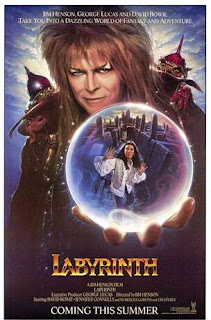
figure C: David Bowie in Labyrinth

This sounds interesting. I'm with you John Burke. Expanding the concept of a concert, melding the sonic experience with a physical and mental task. I'm always fascinated to know what new boundaries composers seek out.

What's the desired affect again? Empowerment?

While there is rarely anything run-of-the-mill about those who follow a career in contemporary classical music, Burke still stands out as unique. He is much more interested, for example, in discussing the notion of the “hero's journey” or monomyth, as described by American thinker Joseph Campbell, than the architecture of his compositions.

How original. If only Strauss or Wagner or Beethoven had thought of this. Damn. Think of the tone poems, operas and epic symphonies they could have composed...

And is the author suggesting that other composers don't read or show interest in non-musical subjects? Nevermind.

But then, he explains, classical composition is what he used to do, before he saw the light.

Praise Apollo!

Burke grew up a choirboy in Toronto, and always considered music to be a deeply sacred activity. After studying at McGill and the University of Michigan, he won a number of CBC composing awards and was funded by the Canada Council to study in France. He returned to Canada to teach at McGill, and subsequently the University Of Victoria. And he continued to compose and record.

Yes, yes. Get on with it.

But eventually, he says, the rarefied and competitive realm of modern composition became too much for him. In 1995, at the age of 44, Burke all but abandoned his successful classical career and hit the road.

This is unfortunately all too true. There often seems to be very little room for classical music in our vast culture, and even less for contemporary classical music. Intense competition for attention is a reality. And on that front I applaude Burke's attempts to find his own niche.

“I had a crisis of confidence in the value system of contemporary composition,” he says.

Come again? "Value system of comtemporary composition" -- what exactly does that mean?

“I found it ego-driven and rife with power issues, even abuse issues – it really brings out the worst in people. Classical music, to me, operates ideally in a spiritual domain – but the internal politics are so nasty.”

The "value system of contemporary composition"? It's "rife with power issues"? Okay, I was with you about competitiveness, but...what?

I assume you're talking about the people...the institutions. Classical music organizations like symphonies and universities are indeed rife with power issues and internal politics, but the actual writing of the music...the politics of that are too much for you?

Burke ended up in Los Angeles, and joined a year-long program run by Don G. Campbell, author of The Mozart Effect theory. He also studied with New Age philosophers and shamanic teachers, and became increasingly convinced of the connection between sound and consciousness.

“I was looking for a way to make music in a more holistic way,” says Burke. “I wanted to consciously send an empowering energy through music.”

New Age. Holistic. Empower. Aren't these just buzz words that dumb people use to sound important?

Three years ago, he was given the chance to test out his theories at CBC's Studio One in Vancouver, who recorded and broadcast the work he had created during his musical rebirth. Enter the Labyrinth: Instead of chairs for the audience, a maze was created in the recording space – everyone would walk as the music played. The result was revelatory.

And what was revealed? Why do people walk through the labyrinth again? How is this breaking away from the politics of classical music?

“This was no longer an audience,” says Burke. “These were participants on a journey, and for some it was a very intense experience.”

Audience participation -- check. I got that part, but how was it intense? What was revealed, again? How were they empowered?

The musicians were amazed too, he insists, despite initial misgivings. “They were facilitating these people walking their path,” he says. “They had become sound healers.”


figure IV: For only $995 with no required tests, classes, books or examinations, you too can receive a genuine Masters in Sound Healing from the Academy of Energy Healing.

Tonight's concert includes music from that original studio session as well as new work, improved, Burke anticipates, by the participation of the Borealis String Quartet (the CBC recording was made with session musicians). But he notes that the simple and direct quality of the pieces – which he describes as having a circular structure specifically designed to work with a labyrinth – would be considered “naive” in the classical world.

Do circular structures in composition negate the power issues and politics of writing music? Do they empower? How about diversify, globalize, or break through the clutter?

And why the jab at the classical music world? Why cast aspersions upon the entire classical music world with this baseless assertion that those elitists just wouldn't get it, or would dismiss it?

I'm here for you, John. I love new ideas, new concepts and ways of thinking about our interactions with music, but don't let me stop you from explaining your piece. After all, it does sound as though you are attempting something interesting and new...

Such slights hardly concern him: “It is not my ego that is at stake here,” he says. “There is an intention of service that changes all the ground rules in a dramatic and interesting way.”

Does your music think outside of the box as well?

So distanced is Burke from his former path, he admits to a complete disengagement with current classical music. A recent concert in Toronto featuring new music by a fellow Canadian composer confirmed his sense of alienation.

“I didn't get it,” he says. “I didn't know what it was meant to be about – it just seemed so last century.”

You mean you didn't like it. Right? Perhaps if you had empowered them, kept them from drinking the Kool-Aid.

You should outsource your message -- Classical Music 2.0, powered by integrated-wiki-paradigm shifting-blogo-chips.

Burke's next move, he says, may well be something other than music: Convinced that the history of classical music can be seen through Joseph Campbell's “hero's journey” structure, he may write a book.

A book. That really would be outside of the box for a music composer.

Wait. Did we ever find out the point of your piece? How it empowers? Or how it heals? Or why this isn't classical music?

How about a history lesson...(make it quick though, this post is getting long...)

“If you consider [music's] infancy to be Gregorian chants, the mid-life crisis to be Wagner, followed by a complete meltdown, then the full circle would be to reach an empowered healing potential through the language of labyrinth,” he says.

And there you have it, folks -- everything after Wagner was "a complete meltdown." But at least we have empowered healing potential.

I personally hope he uses ExtenZe for a larger and more enjoyable musical life.

As for music, Burke says he is unsure what more he can offer.

How about an explanation?

“Maybe,” he suggests matter-of-factly, “my journey as a composer has become complete.”

We can only hope.

----------------------------
Now, I don't wish to distract from what may have been a very interesting event and musical experience. Burke may indeed have created a new and special environment for the collaboration of music and puzzle-solving, but this sort of trite dismal of classical music composers -- from one of its own -- is counterproductive. Let me let you in on a little secret Mr. John Burke, "You're still writing classical music. Sorry. No matter how naive or emotionally, spiritually, physically you may conceive of your music, it's still music based on a tradition that extends back hundreds of years colloquially known now as classical music. And claiming healing powers and adding performance art or audience participation doesn't necessarily change that."

Classical music isn't a disease that needs to cured, nor does it have politics, or values -- there is no exit strategy and it certainly doesn't need synergy. What I hope is that disillusioned, visionary composers like John Burke would be content just to experiment in their attempts to connect more fully with his audience and leave it at that.

At the end of the day, Burke is free to dislike all contemporary classical music, and he can be as proactive as he wants to try and change it, streamline and make it pop. He would follow a long lineage of composers -- like John Cage, Pauline Oliveros, and whoever wrote The Rocky Horror Picture Show -- who have all already experimented with new perspectives in the relationship of music and its audience.

But back off, man...contemporary classical music doesn't necessarily have to baste the turkey, boil the ocean, and get back to a people-centric, 3G, brick-and-mortar fundamentals.

Wait. What?


Whatever. I do what I want.

The Worst Joke Ever?

Wrapping up a puff piece about the Moab Music Festival and its sometimes amusing outdoor intrusions...

Moab's picturesque backdrop sometimes provides a touch of the unexpected. [Festival co-founder Leslie] Tomkins recalled a canyon wren that liked to sing along with a Bach cantata.

...provides the perfect setup for what has got to be one of the worst jokes ever.

This year, she expects nothing less when Schubert's "hilariously appropriate" "Trout" Quintet [...] is performed...

You can just feel the ink itching. Can’t you?

...along the banks of the Colorado River.

Tee hee! Yet one bad joke is trumped by another even worse one. The author’s calculated delay of dénouement is perfectly coordinated to be excruciatingly aggravating.

-

Joke-interrupting intemezzo!

Hooray! The Detritus Review has just expanded its line of quality products! Sator Arepo and I are happy to introduce to you yet one more cynical voice to the world of music meta-criticism: the lovely and talented Gustav!


Figure 2. Gratuitous symbol of change


Also, we’ve reorganized some things, but nothing to concern yourselves with. Soon, however, we are planning to overhaul our links, making sure to include even more Detritus—something we’ve sorely neglected over the past few months. Stay tuned!

-

So how’d that all pan out, with the “hilariously appropriate” “Trout” and river performance?

Maybe the string players will use fishing poles instead of bows. [fin]


Graph 1. Showing bewilderment to laugh ratio as it approaches infinity

8/31/09

Gauche

The abbreviated story of Ravel’s Concerto pour la main gauche en ré majeur, written for pianist Paul Wittgenstein:

In 1930, the French composer Maurice Ravel (author of the famous Bolero) composed the Piano Concerto in D major at the request of an Austrian pianist, Paul Wittgenstein, who, as the title implies, was left-handed.

Well, that’s not quite accurate. See, as the story goes, in World War I, Wittgenstein had been shot in the right elbow and captured by the Russians, then sent to a prisoner-of-war camp in Siberia. At some point during the horrific sequence of events, Wittgenstein’s right arm was amputated.

Thus ends the abbreviated story of Ravel’s Concerto pour la main gauche en ré majeur, for pianist Paul Wittgenstein.

-

Now that you know the story, it’s time to look at this, from the Cleveland Plain Dealer’s very own Zachary Lewis:

In [the pianist’s] hand, the score's downward-dashing motif was like a focused stream of bullets...

[dismay]
-