Showing posts with label Pittsburgh Post-Gazette. Show all posts

4/27/11

The Greatest Review You've Ever Read?

We here at the Detritus have come to learn that great music is great because it's aesthetically and technically stunning, makes money, makes people happy, is liked by more than 216 people, can run 40 yards in 4.2 seconds, and is written by someone famous and dead.

However, these common criteria leave out, arguably, the most important factor...what's in here. [I'm pointing to my gut]

Concert review: Blomstedt, PSO create a Brahms experience
Andrew Druckenbrod, Pittsburgh Post-Gazette, April 09, 2011

We spend an inordinate amount of time trying to define greatness,…


So true. And from what I can tell, it's pretty much an exact science nowadays...

Like when Mel Kiper said of JaMarcus Russell, "Three years from now you could be looking at a guy that's certainly one of the elite top five quarterbacks in this league. Look out because the skill level that he has is certainly John Elway-like."

figure greatest JaMarcus: The epitome of spending an inordinate amount of time defining greatness.

JaMarcus Russell is one of the greatest quarterbacks ever, right?

…and classical music is particularly obsessed with it.

Well, when you only listen to the same 10 or 15 composers who all died over 100 years ago, might as well rank them between sessions of masturbating over which conductor's phrasing of Mahler 4 was ejaculatory enough.

Was that harsh? It felt harsh. Anywho...

But so often it is a debate made away from the music in question…


What do you mean “away”?

… -- in a coffee shop or a classroom, in an article or a book.

And you prefer that debate be made inside the music? Words are my tool of choice when I wish to communicate specific thoughts and ideas. Do you want me to make an argument that Beethoven's music is great with music? I’m not sure I follow.

But what role does experience play?

I’m going to guess that most of the people debating this have experienced classical music before. No?

So Mr. Smarty-pants, how do you define greatness in music?

As of late I have come to define greatness in music as any composition or song that, when listening to it, seems the best work I have ever heard.


Like I said, defining greatness is pretty much down to science these days.

When I am listening to a Beethoven Symphony, I can't imagine another that's "better."


I’m not sure you’re actually familiar with the concept of a definition.

But now that I think about it, our imaginations should be the first criterion for any good definition of the greatness of music.

Same with Chopin's nocturnes and Wagner's operas, Schubert's lieder or Radiohead's albums.

Radiohead does make the best Radiohead albums…although Muse releases pretty good Radiohead albums, too.

No wait...neither of them releases very good Radiohead albums.

But, hey, wait a minute.

What if I can’t imagine a better piece, but I feel like there must be one. Is it necessarily so that imagination is greater than feelings?

I don’t know, because I imagine that you have no idea what you’re talking about, but my gut feeling is that you’re absolutely right.

figure greatest method of transportation: I can't imagine a more seaworthy vessel.

Never mind…

[snip]

Moving along, Brahms' First Symphony was on the program (clearly the greatest symphony ever), as was his First Piano Concerto...

I am happy to report that pianist Garrick Ohlsson is human.


This was in doubt?

He missed a note in his brilliant performance of the First Piano Concerto,...


I really hoped you pointed this out to him after the concert. However, in his defense...

figure concerto: Garrick Ohlsson won't let a little thing like the greatest piano concerto ever get in the way of sweet, sweet vengeance.

…and it actually made me appreciate his amazing virtuosity all the more.

That's exactly how I feel about JaMarcus Russell.

You just had to be there.

Exactly. How else could you experience imagining this was the greatest music ever?

figure greatest present: I can't imagine a more innocent looking gift. How thoughtful.

2/14/10

The Transitive Property of Intermission?

PSO concert's formula equals success

Andrew Druckenbrod, Pittsburgh Post-Gazette, 1/30/2010

Cheesy title notwithstanding, the premise of this review is fascinating.

Intermission at this Pittsburgh Symphony Orchestra concert might as well have been an equal sign in what amounted to a giant musical formula.

(Small quibble, but I think I'd have gone with "equals" sign, but that's just what 1.8 seconds of research suggests is common usage. Also, I asked a mathematician friend of mine.)

Nonetheless: I'm totally intrigued, as I'm interested in the intersection of mathematics and music.

What could this mean?

Figure 1: Which falsely implied that the Pittsburgh Symphony's intermission was a strong statement of support for LGBT equality.

In the first half were two examples of the classical period by Haydn and Mozart, coincidently Violin Concertos No. 2 each performed with ravishing tone by violinist Gil Shaham.

Cheers for the use of the unusual synonym (and near-homonym)-slash-alternate spelling of "coincidentally."

Jeers for...well, a couple of things. There's clearly a comma missing, probably after "No. 2". Either that, or this is a hopelessly garbled paragraph. Er, sentence. Sentence-paragraph.

Moreover, was it really a coincidence that the concerti [sic] were both "number two"s? Like they rolled dice to determine which pieces to perform or something?*

Figure 2: But there's no d5...how am I supposed to choose a Mozart Violin Concerto?**

In the second half was Mahler's manipulation of that classical style in his Symphony No. 4.

Mmm, hmm, mmm-hmm. "That" classical style, eh?

It was almost as if music director Manfred Honeck were a mathematician, carefully balancing the equation to let the audience in on what Mahler was doing.

Ah.

Or rather: What?

I guess the equation is

(Mozart Violin Concerto No. 2) + (Haydn Violin Concerto No. 2) = Mahler Symphony No. 4.

or

2 * ("That" classical style) = Manipulation of "that" classical style.

which implies that

Manipulation = 2

which is, really, no less logical.

Which is to say: Not logical at all. Obviously it's only a metaphor, but it should still work on some level, right? Well, I'm still intrigued, and would like to unpack the metaphor, if possible.

So let's back up.

It was almost as if music director Manfred Honeck were a mathematician, carefully balancing the equation to let the audience in on what Mahler was doing.

First, if it's an equation, it's by definition balanced. Second, the equation metaphor implied that the (or "that") classical style evidenced in the first half is somehow balanced by the Mahler, and, further, that the stylistic balance is achieved...how?***

Nice of him, since the first audiences (and critics) that heard the Fourth Symphony missed the boat pretty badly on this one.

They missed the boat...badly? Were they shooting at it?

Figure 3: Artist's rendering. (Pro tip: You have to lead them a little.)

When Mahler conducted the premiere of his Symphony No. 4 in Munich in 1901, boos rang out in the hall.

This is true, but his reputation as the heavy-handed director of the Vienna Opera and the fervent, pervasive, and increasingly normalized anti-Semitic sentiment in Austria at the time (the mayor of Vienna was openly anti-Semitic) likely played a role in this reaction (although Mahler officially "converted" to Catholicism as a requirement for his post at the Opera).

Or, you know, they just really hated it.

But today, it's hard to understand how the audience didn't realize why he was using ultra-simple themes and orchestration instead of his typical aggressive and sometimes terrifying music.

Wow. Okay...

The orchestra is smaller, sure (no trombones, fewer than 374 horns), but I don't know if (for example) the sleigh bells in the opening bars count as "ultra-simple" orchestration. Also, the characterization of Mahler's music as "typical[ly] aggressive and sometimes terrifying" strikes me as, er, odd. Mahler's music is bucolic, ironic, witty, parodic, occasionally faux-pastoral, nuanced...but not really aggressive. For me, at least.

But let's follow the argument in the service of understanding the metaphor.

After all, he ends the work with a setting for soprano and orchestra of a poem in which a child sings about what heaven is, or might be like.

After all?

Obviously the music was meant to mirror that....

Obviously? What's all this rhetoric about?

...and if you listened closely to Honeck's interpretation of it on Friday night at Heinz Hall, the PSO also revealed Mahler's constant questioning of this child-like state.

That seems closer to the point.

At times, Mahler is reminding us that even the most innocent picture of heaven is tied to Earth.

Figure 4: Mahler's vision went unrealized until 1990.

Mahler achieved this by playing with style -- specifically that classical style of Mozart and Haydn.

I think that hearing the Fourth's perceived classicism as [ironically?] naive and speaking to the poem in the fourth movement is fair.

Surely, though, the metaphorical equation doesn't come down to

Classicism (Mozart, Haydn) = Referential, throwback-y-sort-of Classicism (Mahler's 4th)

...does it? There's more, right? Because that's pretty thin.

It is extremely hard to separate a style of music from the time in which it arose.

Unless we lived in some fantastic, unimaginable, futuristic age where basically any music that was ever recorded by anyone, anywhere was available at our fingertips. That'd be crazy.

If Beyonce were to release a new song in the style of big band jazz or Bruce Springsteen a new Elvis-like rock-n-roll tune, we would see them as throwbacks or tributes, not new explorations.

Maybe. Or as ironic. Or referential, or reverent/irreverent. Or parodic, or evocative--or crossover. Or deliberately and pointedly anachronistic. Or shamelessly commercial. Or lots of things, really, besides throwbacks or tributes. Or this:

Figure 5: Nice fucking font. Er, fonts.

Mahler was counting on this in the Fourth. He expected that by using music from an earlier style that was already 100 years past would evoke a simpler time, much in the way folk music is used today.

[Sentence error 506: missing object. Please fire editor.]

So, in this regard, one can see how early audiences had trouble understanding it.

No, I can't see that. You just laid out a pretty simple (if speculative) argument that it's easy to understand. Besides, you just wrote this a few paragraphs ago:

But today, it's hard to understand how the audience didn't realize why he was using ultra-simple themes and orchestration instead of his typical aggressive and sometimes terrifying music.

Or I guess you were ironically disproving your own assertion? How...Mahlerian.

Honeck's reading succeeded because he treated the galant style of the work sincerely and then upset it by manipulating dynamics.

That' a pretty nice assessment, nuanced and thoughtful. (I'd probably argue that "galant" is not equivalent to "classical" in current musicological parlance. (Perhaps we should check with some musicologists?))****

He kept the work from turning sappy or saccharine. This meant pulling back on the strings even more than he is sometimes wont to do, and it also meant emphasizing the solo elements of the symphony.

Okay, great. I'm losing the thread here, though. Something about an equation?

Principal after principal stepped up with rich and colorful solos, from William Caballero's sometimes radiant, sometimes protesting horn to Michael Rusinek's alternately full-bodied and wailing clarinet to Andres Cardenes' scordatura violin (tuned up a tone).

Scordatura violin doesn't seem like "ultra-simple orchestration" either. Just sayin'.

The latter was a tour-de-force for the concertmaster as he constantly switched violins in the second movement to assume the character of the Devil.

Uh, yeah. No. The character is supposed to be Freund Hein, a mythological German character closer to Death than the Devil, a skeleton who leads a Totentanz and plays the fiddle.
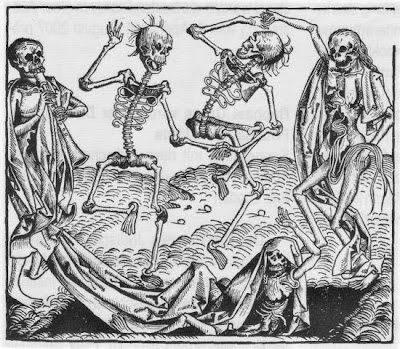
Figure 6: Ein Totentanz. Death is indeed a wily one, as the fiddle he's playing appears to be some sort of clarinet.
Figure 7: Austrian Melodic Death/Thrash Metal band Freund Hein.

Oboist Cynthia DeAlmeida, timpanist Christopher Allen, trumpeter George Vosburgh and the entire cell and bass sections also played crucial roles. Unfortunately, the soprano who sang the song "Life in Heaven" in the finale did not follow suit. Sunhae Im didn't muster the volume and didn't enunciate well. While this must be treated in a child-like manner, the part must be heard.

Again, those seem like valid observations, praises, and criticisms. So what's with the goddamn math metaphor?

Shaham, of course, didn't exist just to set up the Mahler.

I guess he'd be glad to know that.

That was a nice byproduct of his exquisite performance of the two concertos.

Shaham's performances in the first half helped set up the Mahler? Now we're getting somewhere. Right? Equation metaphor? Something?

His reading of Mozart's concerto was inspiring, but the surprise for me was the Haydn, whose unhurried treatment of the exquisite but deliberate middle movement was like watching some spectacular HDTV sports highlight in slow motion.

Either Haydn's treatment of his own middle movement was...like watching sports, or there's a pretty preposterous pronoun problem. Honestly, I'm not sure which is worse. But, hey, at least we're getting to the...

Shaham was far less animated on stage than his last appearance and took the pose of someone humbled by the music. His ability to play legato even in the quickest of runs (especially in his encore, the Preludio from Bach's Partita No. 3) infused this music with winning flair.

Okay, but...

Problem solved: both sides of this equation were equally masterful in the hands of these artists.

That's it? Everything was super? After all that?

Oh, come on! That's a fucking cop out.

Figure 8: Maxwell's Equations, or: Not A Fucking Cop Out


* Of course, "number two" also has the common, if vulgar, connotation of "shit."

** 1d10/2, obviously.

***Still further, if it's an equation it has to hold that the program would be transitive as well as reflexive (that is, it could have worked in reverse order (since both halves are (by definition) equal)), but that's not what's implied here.

****And, yes, I like nested parentheses.

9/5/08

Meta-Meta Nitpicky

Hooray to Mike Lynch of Mike Lynch Cartoons, a fun blog about, what else, cartoons! A week ago, Mike (Mike’s Dad) had found a rather stupid typo on a Pittsburgh Symphony advertisement. Instead of listing Joshua Bell as a violinist (who doesn’t know that, right?), they mistakenly label him a pianist. And as Mike hilariously points out, there’s a “tell” that somehow the advertising department missed:

The "tell" is that Joshua Bell is holding a violin.

Sweet. Hilarious, right? Not so fast.

Andrew Druckenbrod of the Pittsburgh Post-Gazette happened upon Mike’s post and, well, he has a question. Actually it's more of a sneer.

And this was worth a blog post?

Lest you forgot, Andrew, you used space, posting space, if you will, on your blog, which is a blog that has posting space for trivial stuff that one can easily find on many blogs, which often have trivial things on them, in said posting spaces.

Come on, Mr. Lynch. I am sure you have never made any mistakes in your cartoon copy (actually, cartoonists are famous for doing that).

Fair enough. But then again, Mike never said he didn’t. He’s just humorously pointing out a “dopey” mistake—no derision involved, just humor, which is often funny.

If you know my writing here, I am far from an apologist for the PSO, but in my coverage of the institution and its performances, I always go by the philosophy that small errors don't concern me -- it's the big picture that counts.

Then again, Andrew, you’re getting paid to write about music. Mike, however, is not. He’s blogging about what interests him.

Typos interest me, too.

And in this case, I think we can cut the understaffed PSO marketing department a break, especially since the rest of the ad is well done.

Uh... you like the dopey slogan, “Feel the Chemistry?” Or the dopey slogan's silverish-tan letters written across Arabella Steinbacher's tan dress? Okay...

True (constructive) criticism...

Shit. Here comes the high and mighty...

True (constructive) criticism -- not self-serving nitpicking -- might point out that perhaps the PSO could stretch itself a bit for more bold moves in advertising.

Really? If you’re going to call Mike, who merely found the typo funny, a self-serving nitpicker, then let me ask you this: What is the only difference between your blog and Mike’s, Andrew?

But the world is hardly going to end because of this small mistake, and it is not as if mistakes don't occur everywhere...

I suggest Mr. Lynch pick on someone like Berkeley Breathed or Garfield...


This is lunacy. Either that or it’s overly-defensive. I can’t tell which. Are you suggesting that Mike should stick to what he knows, cartoons? He can’t find typos funny? He can’t post about them? On his blog? A freaking blog?!

I’ll ask again: What is the only difference between his blog and yours, Andrew? Give up? Your blog is affiliated with the Post-Gazette (and tons of their ads)! Do you think they want their name attached to your post? You know, the one criticizing a blogger for being nitpicky?

Is it worth a blog post?
-

8/22/08

Dammit, One More Amusement

So the Pittsburgh Symphony Orchestra is going through some tough contract negotiations and, surprise, the piss poor economy is a big factor.

A report a year ago by think tank Rand foreshadowed that such pressures may only grow in a region where two of the biggest funders of arts -- the government and foundations -- are being pulled in other directions, putting more of the burden to raise money from a populace whose numbers have been shrinking.

Wow. And all by themselves. Good work, think tankers! Maybe next year you’ll be promoted to the third grade, where you’ll get to use paintbrushes instead of your fingers!
-

5/7/08

Metaphoric Boos

Today’s winner of the “Failed Food Metaphors” tag comes from Burkhardt Reiter of the Pittsburgh Post-Gazette with his review:

Quartet overcomes venue limitations for intimate concert

We certainly have seen some ham-fisted food metaphors in our day, but what follows just might take the cake.

If the New Hazlett Theater were a martini, it would be a very dry one.

Of course, what he’s saying is that the Theater’s acoustics were dry, meaning dull, boxy and/or non-reverberant. It also helps explain the title: it was a good show despite the hall’s dryness. Fine. No problem.

Unless you prefer your martinis dry.

But here’s where Burkhardt shakes it up, when he’s supposed to stir:

Despite the New Hazlett's acoustic drawbacks, the quartet projected a sense of intimacy in this space that a more reverberatory venue may have lacked.

A contradiction: the dryness of the theater is what made the quartet metaphorically taste sweeter! That is the opposite of a dry martini, sir. See Vermouth. FAIL.

-

Unfortunately, Burkhardt doesn’t stop cooking up metaphors there.

Served as an appetizer to the rest of the concert, the quartet presented three movements from "John's Book of Alleged Dances" by John Adams...


Then,

The meat of the first half was Terry Riley's "Mythic Birds Waltz" and Wayne Peterson's "Jazz Play."


What could possibly be the dessert? I’m dying for chocolate-covered strawberries.

Sadly and wisely, the dessert is only implied. But it’s still rather disturbing, because it's what I’d expect from modernist-hater Bernard Holland, not Burkhardt Reiter and his warm review of newer pieces. It’s...

...(drumroll)...

the only romantic piece on the concert. By. Beethoven! Yeah!

Boo and FAIL.
-

4/4/08

Oh crap! My dealine is in ten minutes. Uh... "Less is more!" Sounds good.

Unlike the Pittsburgh Post-Gazette’s Andrew Druckenbrod, I have nothing to do but sit in my basement all day, cheerlessly blogging about bad musical writing, which is why I can generously waste my time, for you, to dissect this whopping 600 word-long pile of steamy... musical clichés, written in just under ten minutes (I’ll bet my Star Wars cards on it, but not Chewbacca).

Great music is often defined by what isn't written as much as what is.

Cliché. Less is more.

An orchestra's near endless sonic possibilities can be a temptation to which composers often succumb.

Already, he’s riffing like Yngwie J. Malmsteen.

This allure often leads to "overwriting" their material, filling in the precious spaces in which the music breathes.

It just goes on and on...

Less is usually more.

...and the clichés keep piling up.

Yesterday's Pittsburgh Symphony Orchestra concert at Heinz Hall brought the issue to the fore. Not only did it include Chopin's Piano Concerto No. 2, a work whose heavy-handed orchestral writing is leagues away from the ultra-sophistication of his solo piano music, ...

Has anyone ever proven that Chopin sucks at orchestration? Or has it been around for so long that it’s become an old wives' tale? Either way, it’s as familiar as the old adage, “Brahms is dense and Carter is difficult,” from The Art of War.

As enjoyable as it was to hear both pieces under Swiss conductor Charles Dutoit and by Emanuel Ax, I could not help but think just how satisfying it is when composers have the guts to ask for a certain instrument but only use it when they want.

Yngwie J. Malmsteen.

There's no unnecessary extra writing for the trumpets, bass trumpets and tenor tubas (Wagner tubas in these concerts) in "Sinfonietta" just to please their players.

Janacek = not Ygnwie J. Malmsteen

It's about the music.

Ugh.

And what a fun piece "Sinfonietta" is.

Andrew Drukenbrod = not Yoda

The main reason composers selectively use instruments is for color.

Yoda is a fictional character. I breath air. The world is flat. Yngwie J. Malmsteen riffs. Orchestration is the selective use of instruments for color.

And none were better at that than Ravel and Debussy.

By the way, did you hear the one about Chopin? Turns out he couldn’t orchestrate well. That reminds me, did you hear the one about Debussy?

Debussy's "Jeux (Games)" was awash in color, often coming in waves, in a fleeting depiction of a tennis match leading to amorous activity (and to think Maria Sharapova and Anna Kournikova weren't even born then!).

1. Are the quotation marks correct?

2. Did you hear the one about Maria Sharopova and Anna Kornikova? They make appearances in a classical music review about a piece that references tennis and sex.


Dutoit's sensitive conducting alternated between continuous arm movements and abrupt stops, depending on if the work called for surface fluidity or rhythmic underpinning.


But that's the definition of conducting, only more convoluted! Drukenbrod = Stuffit Expander.

That Dutoit continues to be a master of the French repertoire was abundantly clear.

Drukenbrod = Yoda?

Ax's light attack not only fit Chopin's phrasing for the pianist, but lent the concerto an improvisatory spirit (I could swear he gave a few extemporaneous flourishes, too). The only downside was it further exposed Chopin's stilted writing for orchestra.

No. Drukenbrod = Yngwie J. Malmsteen

Clearly the best parts of this work occur when the pianist plays.

Clearly the best part of this review is when the reviewer reviews.

Ax substituted for Alfred Brendel three weeks ago. It would be a shame not to hear him again for a while.

Less is more.